


Disneyland Paris is a park you can visit ten times and rediscover on every trip. Behind every facade and every ride, the Imagineers (the people who design the Disney parks) have slipped in hidden details, tributes and stories that most visitors never notice. After so many visits, I’ve got into the habit of hunting down these little secrets.
In this guide, I take you land by land through the best-known ones, then point you to my dedicated articles for the full lists. And for the story behind the scenery, it’s all in my section on the history of Disneyland Paris.
Secrets of Main Street U.S.A.
Right from the entrance, Main Street U.S.A. hides several details you walk past without noticing:
- The passage under the station. Just before Town Square, the ceilings under the Main Street station were deliberately lowered. That squeezed feeling is intentional: it heightens the sense of scale and freedom as you come out onto the street and see the castle (compression followed by release).
- The forced perspective of the street. The upper floors of the buildings get smaller as they go up. On the way in, this makes the castle look bigger and further away than it really is. On the way back, from the castle, the exit seems very close.
- The Emporium dome. Above the big shop, a glass dome pays tribute to great inventors: Thomas Edison, the Wright brothers, Nikola Tesla, Alexander Graham Bell and others.
- The 48-star flag. On top of the Emporium, the American flag has only 48 stars: the America of the late nineteenth century, before Alaska and Hawaii joined the Union. As they aren’t official flags, the park doesn’t have to light them at night or lower them in bad weather.
- The cash carriers. Look up inside the Emporium: an old rail network runs along the ceiling. Cashiers used to send money along it to the offices upstairs, which sent back the change. A period relic turned into decor.
- The dates on the facades. The dates carved on the buildings aren’t decorative, they’re tributes. The Storybook Store bears "1891", the year Walt Disney’s grandfather died.
- The EDRR initials. Around the Main Street station, look for the letters "EDRR" in the ironwork and on the railings. They stand for Euro Disneyland Railroad, the train’s original name at the 1992 opening, when the park was still called Euro Disney. The carriages have since been repainted "Disneyland Railroad", but these engraved initials have stayed.
- Liberty Arcade and the Statue of Liberty. The covered gallery on the right of Main Street is a quiet spot, often overlooked, that tells the story of the building and unveiling of the Statue of Liberty. At its centre, a diorama in semi-darkness (the Statue of Liberty Tableau) recreates the ceremony. The green-tinted lamps echo the statue’s copper patina. A setting found only at Disneyland Paris, perfect for a quiet break.
- The tribute windows. Look up at the upper floors of Main Street: the windows show the names of businesses that don’t exist. They’re actually tributes to the people who created the park. The most fun to spot: the office of "Dr Bitz, dentist", a nod to Eddie Sotto, one of Main Street’s designers.
- The steaming cup. On top of Main Street Motors, an old-style painted advert shows a large cup. Watch it closely on certain days: real steam comes out of it, a detail almost nobody notices.
- The eavesdropping telephone. At the very back of Market House Deli hangs an old wall telephone. Pick it up and you’ll overhear a period conversation between two Main Street residents. A little sound gag that very few visitors think to try.
- The opening plaque (1992). Inside City Hall, a plaque commemorates the opening on 12 April 1992, a gift from the Tokyo Disneyland teams. A reminder of the days when the park was still called Euro Disney.
- The moustache mirror. At Dapper Dan’s, the shop inspired by an old-fashioned barber’s, a mirror is decorated with drawn-on moustaches. Stand in front of it to "try one on": ideal for a fun photo.
Secrets of Fantasyland
The most visited land has its share of surprises too:
- The Evil Queen at the window. Above the Blanche-Neige et les Sept Nains ride, keep an eye on the window: the witch regularly appears to spy on passers-by, then draws her curtain again.
- A tour of Europe. The scenery of Fantasyland nods to different European countries, from the French-inspired castle to houses that recall Italy, Germany or England.
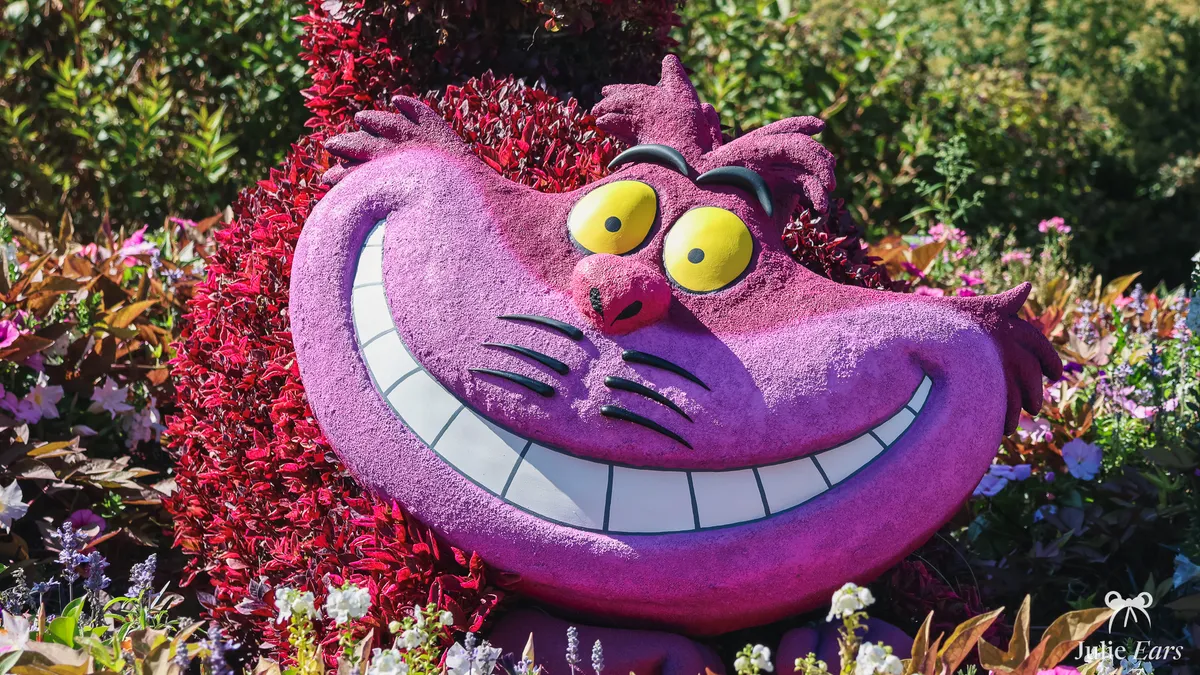
- The Central Plaza topiaries. On Central Plaza, the open space at the foot of the castle, new plant sculptures of Disney characters (seasonal displays) dress the flower beds, starting with the Cheshire Cat (Alice in Wonderland), now joined by Tick-Tock, the crocodile from Peter Pan.
- The mosaic on the Bella Notte terrace. At Pizzeria Bella Notte, the terrace is paved with a colourful mosaic by Mary Blair, the artist behind the look of "it’s a small world". It dates from 1967 and originally decorated a ride at Disneyland in California (Adventure Thru Inner Space). Saved when that ride closed, it crossed the Atlantic and ended up here. You’re having lunch in the middle of an artwork more than fifty years old.
The castle’s secrets deserve an article of their own: I cover them in my guide to the castle’s secrets.
- Peter Pan: the Kirriemuir gate. In the queue, look for a gate marked "Kirriemuir": the Scottish town where J.M. Barrie, the creator of Peter Pan, was born.
- it’s a small world: the clock parade. Every 15 minutes, a door opens beneath the clock on the facade and a parade of little figures comes out.
- The lances of Le Carrousel de Lancelot. The ride’s outer pillars aren’t just columns: they’re knights’ lances.
- Snow White’s hidden axe. Next to the ride, in the bushes, a small tree stump hides an axe stuck in it, as if the woodcutter had just left it there.
- La Chaumière des Sept Nains. Each dwarf has his own little bed, and seven mugs hanging from a beam each bear a dwarf’s name (in English).
- The Three Fairies in the chimney. At La Confiserie des Trois Fées, look up: Flora, Fauna and Merryweather flit about inside the chimney.
- The clogs at the Auberge. In the courtyard of the Auberge de Cendrillon, old wooden clogs hang on the wall, a rustic detail that sets the village scene.
- The zodiac clock. On a shopfront in Fantasyland, a clock shows the signs of the zodiac instead of the usual hours: look up to spot it.
- The castle’s golden snails. Look up at the gilded spires of the towers: little golden snails are hiding there, a nod to Burgundy. The castle holds plenty of other secrets, which I cover in my guide to the castle’s secrets.
Secrets of Frontierland
Frontierland, themed on the American West, slips in a few nods:
- The dinosaur skeleton. From Thunder Mesa Riverboat Landing, the boat that sails around Big Thunder Mountain, look out near the geysers for a T-Rex skeleton set in the rock, as if it had been trapped there millions of years ago.
- The steam tractor. Near the entrance to Big Thunder Mountain stands a period American steam tractor (nineteenth century), bought from a family in Missouri in 1992. The story goes that the sale finally allowed the husband to buy his wife a ring.
- Phantom Manor’s obsession with 13. Inside the haunted manor, the clock shows a 13 instead of a 12 and its hands turn backwards, a nod to the supposedly unlucky number. The manor takes the joke as far as the queue time board, which is regularly set to 13 minutes.
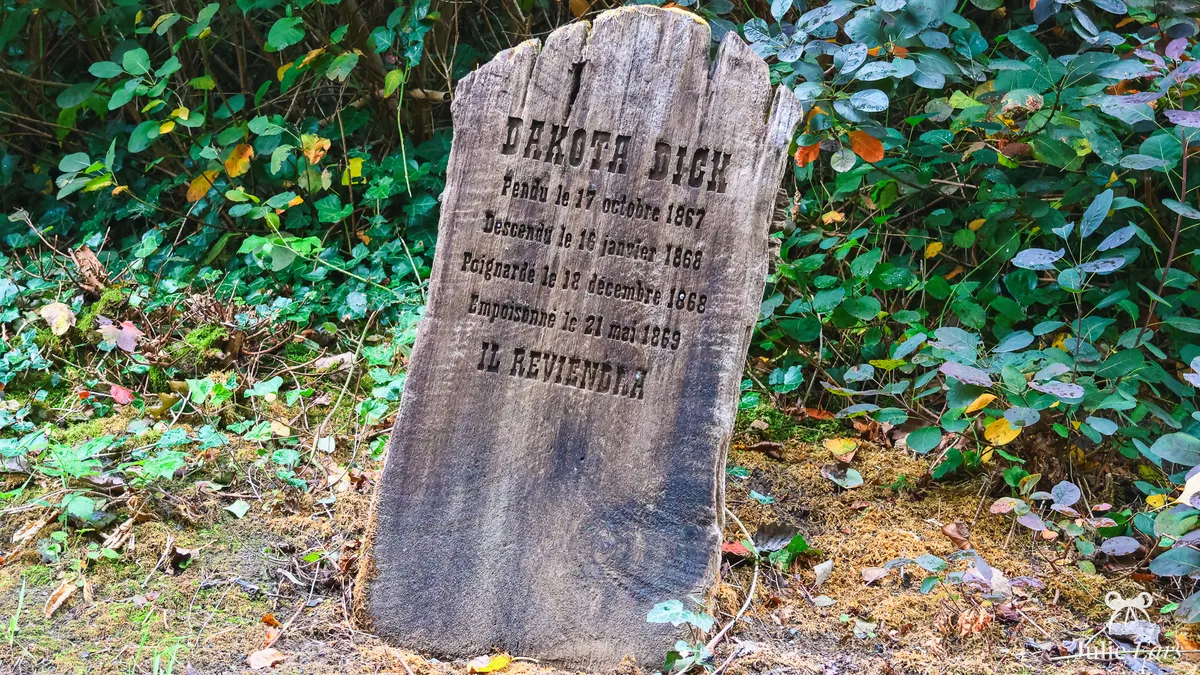
- Boot Hill cemetery. Just before Phantom Manor, on the grassy bank, a small cemetery lines up graves with darkly funny epitaphs. My favourite: the one for Dakota Dick, a bandit "hanged, shot down, stabbed and then poisoned" over the years, under the worrying promise "He will return". Take the time to read the inscriptions, they tell the story of the Ravenswood family who haunt the manor.
- Fort Comstock. The log fort guarding the entrance to Frontierland doesn’t get its name by chance: "Comstock" refers to the Comstock Lode, the richest silver mine in the US in the nineteenth century, right in line with the land’s silver rush theme. It houses Legends of the Wild West, a walk-through that’s often overlooked.
- Stagecoach tracks and horseshoe prints. Look down as you walk through Frontierland: the ground keeps the prints of horses’ hooves and stagecoach wheels, as if a wagon train had just passed. A detail that adds to the Western atmosphere without you even noticing.
- Zorro hidden in the decor. At the Lucky Nugget Saloon, a mural hides the figure of Zorro: he’s there in the scenery but discreet, easy to spot once you know where to look.
- The banging shutter at Phantom Manor. On the manor’s main facade, at the very top on the right, a broken shutter flaps in the wind. Listen carefully as you get closer: you can hear it bang. For the full story of the manor and the Ravenswood family, see the Thunder Mesa saga.
Secrets of Adventureland
Adventureland is probably the land that feels furthest from home, with areas that evoke the Middle East, Africa, India and the Caribbean:
- Adventure Isle and its caves. The central island is riddled with passages, caves and bridges to explore, including Ben Gunn’s Cave and a skull-shaped rock.
- The Swiss Family Treehouse tree. At 27 metres tall, it towers over Adventure Isle, which makes it the tallest tree in the park. It’s a made-up species invented by the Imagineers, the Disneyodendron semperflorens grandis: concrete roots, metal branches and several hundred thousand artificial leaves, each one fixed by hand.
- The pirate galleon. The pirate ship moored near Pirates of the Caribbean is a life-size play area that visitors in a hurry often walk straight past.
- A restaurant hidden inside Pirates of the Caribbean. The Blue Lagoon (renamed Captain Jack’s) is built right inside the ride. Sitting on a Caribbean beach at the water’s edge, you watch the boats of visitors on the ride glide past just a few metres away. It’s one of the few places where you can see a scene from the ride without getting on board.
- Le Passage Enchanté d’Aladdin. In the alleys of the Bazaar, at the entrance to Adventureland, a mosaic archway opens onto a free walk-through with no queue. A series of scenes tells the story of Aladdin, from the Agrabah market to the Cave of Wonders. Most visitors walk past without noticing it: it’s one of the park’s best-kept secrets.
- The Bazaar chandelier. At the entrance to Adventureland, under one of the Bazaar’s arches, hangs a gold chandelier given by King Hassan II of Morocco. The benches below aren’t there by chance: they break up the flow of the crowd and stop maintenance vehicles from damaging this gift.
- The first loop in a Disney park. Indiana Jones and the Temple of Peril, which opened in 1993, was the very first roller coaster in any Disney park in the world to have a loop. Its queue is set in an abandoned archaeological dig, as if the mine carts were used to clear debris from the temple.
- The empty spider cage. Next to the Indiana Jones Adventure Outpost, a wire cage stands wide open… and empty. The story goes that a huge tarantula escaped from it.
- The Indiana Jones queue tells a story. It’s set on a dig site: on the ground, big cat paw prints suggest a tiger is on the prowl, and further on you’ll spot Indiana Jones’s tent, with his hat and whip lying on the bed.
- The wreck of the Swiss Family Robinson’s ship. Near the suspension bridge on Adventure Isle, look for the remains of a stranded ship: the Swallow, the Robinson family’s boat (the family from the treehouse in the giant tree).
- The two spying cats. At the exit of Pirates of the Caribbean, look up: two cats are watching you from the top of the beams.
- The giraffe and the swords. In the La Girafe Curieuse shop, look up to say hello to the giraffe. And next door at Shéhérazade, swords are stuck in the ceiling.
- The gurgling cooler. At the Cool Post, on the Route de la Soif, open the old Coca-Cola cooler: you’ll hear the sound of a soft drink being poured.
- The treasure and its guardian. In the caves dug beneath Adventure Isle, a treasure is guarded by a skeleton, waiting to be found as you explore the underground passages.
- The Roc’s egg. A giant egg sits in its nest: it belongs to the Roc, the mythical bird from the tale of Sinbad the Sailor (One Thousand and One Nights).
- The designers’ initials. At the entrance to the land, on the mosaic archway near the torches, look for the letters WDI (Walt Disney Imagineering, the people who designed the park), topped with a compass, the symbol of Walt Disney’s "True Life Adventures" documentaries.
- The smoke from Aladdin’s lamp. At the Aladdin photo spot, smoke sometimes drifts out of the Genie’s lamp, as if he were about to burst out.
Secrets of Discoveryland
Discoveryland, inspired by the visionaries Jules Verne and Leonardo da Vinci, is packed with references:
- Space Mountain, formerly Discovery Mountain. The ride was originally meant to be called Discovery Mountain and take up the whole land. The letters "DM" can still be seen in the queue, and the ceiling of the last room hides the Imagineers’ initials and dates of birth, drawn among the stars. I tell the whole story in my article on the history of Space Mountain.
- Café Hyperion. Its name pays tribute to the address of one of Walt Disney’s first studios in Hollywood, on Hyperion Avenue. The airship moored at the entrance, from the film The Island at the Top of the World (1974), belonged to Captain Brieux: he mysteriously vanished on the morning of his 50th voyage, after completing 49, leaving his craft in the hangar that became the restaurant.
- The Orbitron quote. Under the ride’s sign is a line from Leonardo da Vinci: "Il sole non si muove" ("The sun does not move").
- Les Mystères du Nautilus. The submarine of Captain Nemo that you see in the lake isn’t the one you visit: the interior is a separate building, out of the water. And the organ in the grand salon is the original one, from the Disney film 20,000 Leagues Under the Sea (1954).
- The shop window frozen in 1992. Outside the Constellations shop, walk round the left-hand side: one window has stayed exactly as it was when the park opened in 1992.
- The land’s vehicles mural. Still at Constellations, look at the carved mural on the facade: it shows the vehicles of Discoveryland (the Star Tours Star Speeder, an Autopia car, the Café Hyperion airship, the Nautilus…).
- The "made in Glendale" batteries. In the Buzz Lightyear queue, look at the batteries stacked near the railings: they were made in Glendale, California, home to the headquarters of the Imagineers who design the parks.
- Jules Verne’s motto. At the entrance to the land, a sign quotes Jules Verne: "Anything that is within the limits of the possible must be and will be accomplished." Quite a mission statement for a land dedicated to visionaries.
- The Café Hyperion pigeons. Under the airship, at the outside entrance to Café Hyperion, a cage houses some birds… that aren’t quite as still as they look.
What about Disney Adventure World?
The second park, Disney Adventure World (formerly Walt Disney Studios Park), has its secrets too. They’re less well documented for now, and the park is changing fast (Avengers Campus, World of Frozen, The Lion King coming soon), so I haven’t uncovered everything yet. Here are the first ones I’ve spotted, land by land, which I’ll add to over my visits.
Secrets of World Premiere Plaza
World Premiere Plaza, the park’s entrance area themed on the golden age of Hollywood, slips in lots of nods to Disney and Pixar films:
- K.WDI 140.1 FM radio. On a shed in the service alley, a radio frequency is painted. "WDI" stands for Walt Disney Imagineering (the people who design the parks), and "140.1" refers to 1401 Flower Street, their address in Glendale, California.
- The Buy n Large sign. A "for sale" sign is signed "BnL", for Buy n Large, the fictional corporation that took over the planet in the Pixar film WALL-E.
- Joe Gardner’s piano lessons. A poster offers piano lessons by "J. Gardner", a nod to Joe Gardner, the jazz-loving music teacher who stars in the Pixar film Soul.
- The Dinoco adverts. Old adverts promote Dinoco petrol, recognisable by its stegosaurus logo: the highly sought-after sponsor in the Cars world.
- The characters’ Walk of Fame. Just like in Hollywood, stars set into the ground honour Disney, Pixar and Marvel characters: Mickey and Minnie, Mufasa, Woody and Buzz, Spider-Man, then Elsa and Anna, Lightning McQueen… keep an eye out as you walk.
- The Burbank office windows. On the upper floors, the windows recreate Walt Disney’s historic offices at the Burbank studio, with little scenes: Walt’s office, the animation department, a statue of Mickey as the sorcerer’s apprentice, and even Dumbo.
Secrets of Marvel Avengers Campus
Marvel Avengers Campus, built on the former Backlot, is full of details for superhero fans:
- The living F.R.I.D.A.Y. facade. The huge facade of the Avengers Assemble: Flight Force building isn’t just scenery: it is F.R.I.D.A.Y., Tony Stark’s artificial intelligence. A giant screen hidden behind panels makes it react in real time (it turns red when there’s a threat and announces the Avengers’ comings and goings). A first for the Disney parks, and exclusive to Paris.
- Real props from the Marvel films. In Spider-Man W.E.B. Adventure, some pieces of the set are props actually used in filming: light fittings seen in Ant-Man, and Dr Arnim Zola’s computer screen glimpsed in Captain America: The Winter Soldier.
- Peggy Carter’s office. Inside the Stark Factory restaurant, one room recreates Agent Peggy Carter’s office, left untouched since the 1950s, as if rediscovered when Tony Stark restored the old factory.
- Labels full of nods. Look closely at the labels around the set and you’ll spot hidden references: "Canelo" (the garage from the series Agents of S.H.I.E.L.D.), "In a Snap" (Thanos’s finger snap) or "WDI 1401", the Imagineers’ historic address.
- The Black Widow stunt team. A little design secret: the stunt coordinators from the film Black Widow helped train the performers who play the land’s superheroes, to make their moves more convincing.
Secrets of Worlds of Pixar
Worlds of Pixar (formerly Toon Studio) brings together the worlds of Pixar, with carefully crafted details in every ride:
- The fake shops of Sydney. The outdoor queue of Crush’s Coaster recreates Sydney harbour at sunset, dotted with made-up adverts from Finding Nemo: the "Port Jackson Diving School", "Whale Watching" cruise posters… to read as you shuffle forward.
- Every ride is different. The turtle shells spin freely depending on how the weight of the passengers, sitting back to back, is spread: no two rides are ever the same.
- The dropped name "Turtle Twister". While it was being designed, the ride was meant to be called Crush’s Turtle Twister. The name was dropped as too hard to pronounce, especially with a French accent.
- The hidden release dates. In Toy Story Playland, look for the numbers "112295" (22 November 1995, the film’s US release) and "270396" (27 March 1996, its French release) tucked away in the scenery.
- Scenery made of real giant toys. Here, you’ve shrunk to the size of a toy: the benches are Lincoln Logs, the low walls are dominoes, the lamp posts are giant Tinkertoys and a 4-metre Buzz Lightyear keeps watch at the entrance.
- Andy’s giant footprints. As you walk through Toy Story Playland, spot Andy’s huge footprints on the ground, as if he’d only just left his garden.
- The canyon and its mini earthquakes. The canyon scene in Cars ROAD TRIP reuses the set and the ~265,000 litres of water from the former Studio Tram Tour. Small earthquakes strike at regular intervals.
- The 60s station. The Cars ROAD TRIP boarding area has pastel 1960s architecture, with wheel-shaped paving stones and a tourist information post, in the spirit of Route 66.
- Mater’s art gallery. Along the Cars route, Mater (the tow truck) shows off his sculptures made from scrapyard parts: you’ll recognise the Great Wall of China and the Statue of Liberty.
- The forced perspective of La Place de Rémy. The upper floors of the facades are deliberately narrower than the lower ones: a "cartoon" effect that makes the buildings look taller.
- The new Ratatouille queue (2026). After its refurbishment (reopened in spring 2026), the ride reveals a new scene: a Parisian artist’s studio, with canvases on the walls and splashes of paint.
Secrets of Adventure Way
Adventure Way, the promenade linking the lands (opened in 2026), takes great care over its Art Nouveau setting and its little nods:
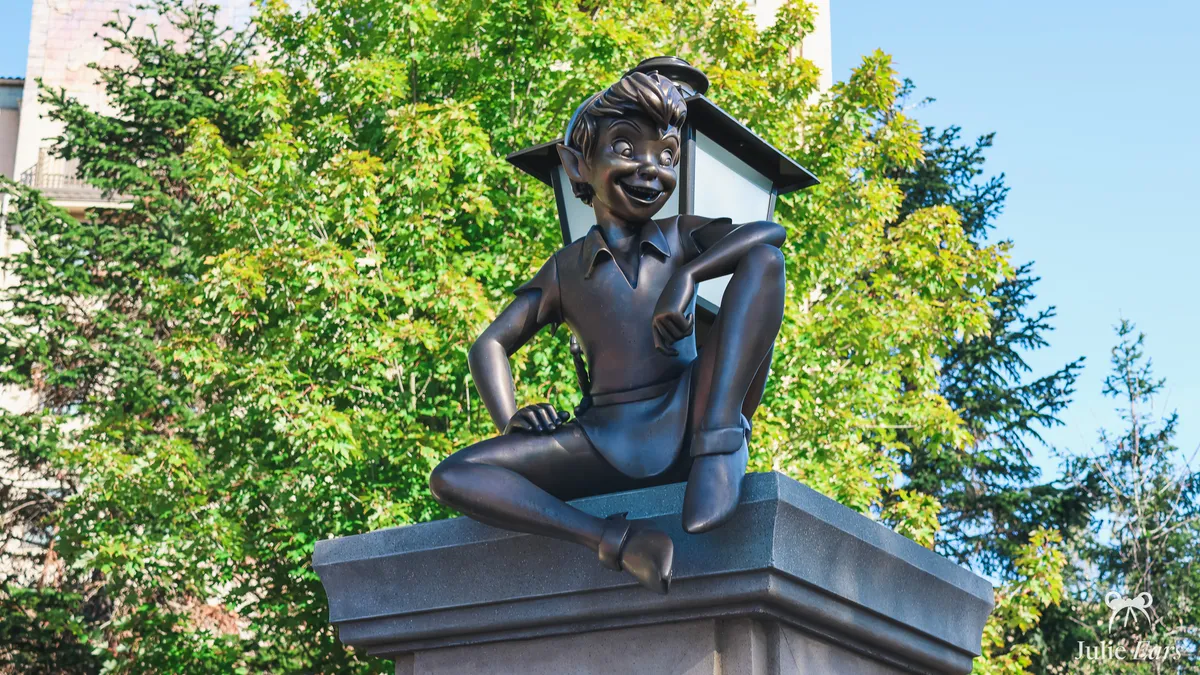
- The bronze statues of the Gazebo Garden. This English-style garden, dedicated to character meets, is dotted with bronze statues paying tribute to British Disney stories: Peter Pan about to take off, Winnie the Pooh and Pongo surrounded by his Dalmatians.
- Nearly 10,000 "popcorn lights". The trees and facades are decked with nearly 10,000 small bulbs nicknamed "popcorn lights", inspired by the Tivoli Gardens in Copenhagen, which Walt Disney visited in 1951. Spectacular as night falls.
- Philippe Rombi’s music. The land’s original soundtrack, by Philippe Rombi, slips in subtle hints of the themes from Peter Pan, 101 Dalmatians and Tangled, each nod playing near the matching garden.
- Art Nouveau from top to bottom. Buildings and street furniture pick up the curved lines and floral patterns of Art Nouveau, inspired by Alphonse Mucha and the architect Jules Lavirotte. The two gazebos feature hand-made stained glass.
- The princesses’ companions. At the Regal View bar (the first lounge bar in a Disneyland Paris park), spotlights pick out the princesses’ loyal companions inside the golden bar counter: Pascal (Tangled), Mushu (Mulan) and Hei Hei (Moana).
- The lantern sky of Raiponce Tangled Spin. The ride recreates the lantern festival from the film: a ceiling of glowing lanterns hangs above the gondolas, to the songs "I See the Light" and "Kingdom Dance". The effect is especially striking after dark.
- The Pont des Lumières. This is a swing bridge: its deck pivots to let boats through during the night-time show on the lake.
- Rapunzel’s garden. In the Jardin Raiponce, a peaceful pond reflects the willows and the rowing boat of Rapunzel and Flynn Rider. The princess has "left behind" a few brushes and paints, next to a mural telling the story of her adventures.
Secrets of World of Frozen
World of Frozen, the village of Arendelle (opened in 2026), is full of references to the film and Scandinavian nods:
- Facades in Elsa’s and Anna’s colours. Around Nordic Crowns Tavern, the facades tell a story through their colours: one side in purple and blue for Elsa, the other in green and yellow for Anna.
- Bruni the salamander. Bruni, the fire spirit from Frozen 2, is hidden in three places in the land: near the lighthouse, on a pergola and on a rock by the water. A fun little game of spot the salamander.
- The one-legged tin soldier. Above the entrance to Arendelle Boutique, a little wooden soldier missing a leg pays tribute to the tale "The Steadfast Tin Soldier" by Hans Christian Andersen, the author who also inspired Frozen.
- The Nordic Crowns Tavern cat. A cat is perched in a dormer window above the tavern entrance, a reference to the featurette "Olaf’s Frozen Adventure".
- Boat names in Danish. The boats moored in Arendelle harbour have Danish names, including "Snødronningen", which means The Snow Queen.
- The Anna and Hans rowing boat. Near the jetty, a small rowing boat recreates the one Anna falls into at the very moment she meets Prince Hans, at the start of the first film.
- The Arendelle postbox. Near Arendelle Boutique, a postbox lets you send real postcards, stamped from the village of Arendelle.
- The "Samantha" newspaper cutting. A fake Arendelle newspaper reports that "Samantha" has finally been found: a nod to Olaf’s running gag in Frozen 2, where he keeps calling out for a Samantha nobody knows.
- The Clock Tower. The Clock Tower, which leads to the Frozen Ever After queue, houses statues of Anna and Elsa and stained-glass windows that glow blue as night falls.
- The book "The Snow Queen". In the Frozen Ever After queue, you can see a book called "The Snow Queen": Andersen’s tale that inspired the Disney films.
- Young Anna and Elsa’s height marks. In the first room of the A Royal Encounter with Elsa and Anna queue (inside the castle), a column bears the height marks of Anna and Elsa as children, just like in a real family home.
- The designers’ names on the books. At the exit of A Royal Encounter with Elsa and Anna, a bookcase shows on its book spines the names of the artists and Imagineers who designed the land.
- The Sven figurehead. For the lake show, Kristoff’s longship has a figurehead in the likeness of Sven, his reindeer. The longships were built with a shipyard on the Arcachon Bay.
What about Disney Village?
Between the parks and the hotels, Disney Village is going through a major transformation (2023-2027): many of its original details have gone or are about to go. One secret is still in plain sight: the PanoraMagique balloon, whose envelope shows Disney characters in full flight (Dumbo, Peter Pan, Buzz Lightyear…), in a retro hot-air balloon style. For the rest, I cover what has closed or changed in my article on the lost places of Disney Village, and I give the full picture in my Disney Village guide.
Behind the scenes: the environmental commitment
Not every secret is visible. Behind the scenes, Disneyland Paris runs a real environmental programme, a subject close to my heart, built around several areas: emissions, water, waste, materials and biodiversity. A few figures published by the park say more than any long speech:
- Energy. The solar canopy over the visitor car park produces around 36 GWh of electricity a year, the equivalent of the consumption of a town of 17,400 people. Geothermal energy also covers 18% of the heating and hot water needs of the parks and the Disneyland Hotel, and a thermo-refrigerating heat pump (a machine that produces heat and cold at the same time) has cut natural gas consumption by 14% compared with 2019.
- Water. Thanks to its wastewater treatment plant, the park has saved 4.9 million m³ of drinking water since 2013, by reusing treated water instead of drawing on drinking water.
- Waste and materials. Food waste fell by 17% between 2022 and 2025, and 31 tonnes of costumes (nearly 43,000 items) were recovered and reused in the 2024-2025 season alone.
- Biodiversity. Over 400 nest boxes and shelters have been installed across the resort to welcome beneficial species.
It’s a side you’d never suspect while visiting, but it says a lot about what goes on behind the scenery.
Even more secrets to look for
The park hides much more. To keep the hunt going:
- the Hidden Mickeys, the Mickey silhouettes hidden by the hundreds throughout the scenery
- the park’s secret passages and hidden places
- the treasure hunts to do as a family, in Adventureland and Frontierland.
Frequently asked questions
01 What is a Hidden Mickey at Disneyland Paris?
It’s a Mickey silhouette deliberately hidden in the scenery by Disney’s Imagineers: a large circle for the head, two small circles for the ears. You’ll find them in queues, murals, furniture and even on the ground. Spotting as many Hidden Mickeys as possible is a very popular game, and I share a list in my dedicated article.


