



You can love this story without ever having set foot on a single one of these rides, and that’s the whole point. For its Paris Frontierland, Disney came up with a complete, carefully crafted tale that plays out across three places at once. I’ll tell it here as a story, based on the official version (the Disneyland Paris one, which sometimes differs from the other parks).
Then I’ll go behind the scenery: how, by whom and in what context these rides were really built. You’ll see: once you’ve got hold of the thread, you’ll never look at Frontierland the same way again.
The story of Thunder Mesa: the town born of gold
Thunder Mesa is an imaginary town in the American West, sitting at the foot of a red mountain in a hostile desert. Its fate can be summed up in one sentence: it was born of gold and died of the curse that guarded it.
In the middle of the nineteenth century, prospectors head into the region in search of ore.
The discovery of a rich seam of gold in Big Thunder Mountain sets off a rush: within a few years, the desert is covered by a lively town, with its Wild West businesses (the fortified entrance to Fort Comstock, the Thunder Mesa Mercantile Building, the Lucky Nugget Saloon founded in 1858 by Miss Diamond Lill). This is where the man at the centre of everything enters the scene.
Henry Ravenswood, a prospector born in 1795, strikes the seam in 1853. He founds the Thunder Mesa Mining Company and becomes the owner of the Big Thunder Mountain mine and the richest man in the region. The town of Thunder Mesa grows up around his fortune. On Boot Hill, the hill that overlooks the town and is dedicated to its founding families, he has a grand Victorian mansion built, where he settles with his wife Martha (born in 1802) and their only daughter, Melanie (born in 1842). The town cemetery, where the Ravenswood graves lie, is on this same hill.
That’s the setting. A thriving town, a powerful family, a mountain full of gold. Everything seems in place for success, and that’s exactly when the story takes a turn.
The story of Big Thunder Mountain: the cursed mountain
Before the gold prospectors, there was a legend. According to local Native American folklore, Big Thunder Mountain is home to the Thunderbird: a guardian spirit in the form of a giant bird, watching over the gold and silver hidden in the mountain.
Anyone who dares to steal its treasure faces its anger, and a single beat of its wings is enough to unleash lightning and trigger an earthquake. Henry Ravenswood, for his part, never believed these stories.
For a few years, the mine produces large amounts of gold, and the curse seems to be nothing more than superstition. But the gold eventually runs low. To keep digging, the miners bring out the dynamite and blast deep into the rock. This desecration awakens the Thunderbird, and the strange happenings start again: the mountain rumbles, the wagons run wild, the mine spins out of control. That’s the chaos you experience on board the mine train.
At Disneyland Paris, this mountain has a special place. Big Thunder Mountain, which French visitors often call Le Train de la Mine, stands on an island in the middle of the Rivers of the Far West, where other Disney parks usually put Tom Sawyer Island. You reach it from a station on the riverbank, through two tunnels that run under the water to the island: something you’ll only find in the Paris version.
It’s also a runaway mine train, in other words a rollercoaster themed as a mine gone out of control.
For the practical side (the queue, the minimum height, the thrills), it’s all on the ride page: Big Thunder Mountain. Here, the main thing to remember is that this mountain isn’t just a big rollercoaster: it’s the cause of everything that follows. Henry Ravenswood owned its mine, and that’s what directly links the mountain to the Ravenswood mansion.
The 1860 disaster and the haunted trains
In 1860, the Thunderbird’s anger reaches its peak. A massive earthquake strikes Thunder Mesa: it destroys the mine, sends part of the town crashing into a canyon and kills many residents, including Henry Ravenswood and his wife Martha. Robbed of its founders and its gold, the town is gradually abandoned.
After the disaster, something strange is reported: the locomotives are found racing round the mountain on their own, with no driver or crew, as if possessed. That’s where the ride as you know it comes from: the Big Thunder Mountain Railroad is set up in the old mining camp so visitors can climb aboard these runaway trains and relive the curse.
The 1860 earthquake doesn’t only destroy the mountain: the same tragedy sets off the story of the Ravenswood mansion.
The story of Phantom Manor: the bride and the Phantom
The Ravenswood mansion, on its hill, looks down over the town and the mountain. It’s the setting for the darkest part of the tale. And it’s one of the few versions of the Haunted Mansion to have a real official backstory, rooted in the American West rather than in a generic mansion.
Melanie grows up in this mansion, one of the most eligible young women in Thunder Mesa, courted by many suitors. The problem is her father: Henry can’t bear the idea of seeing her leave with another man.
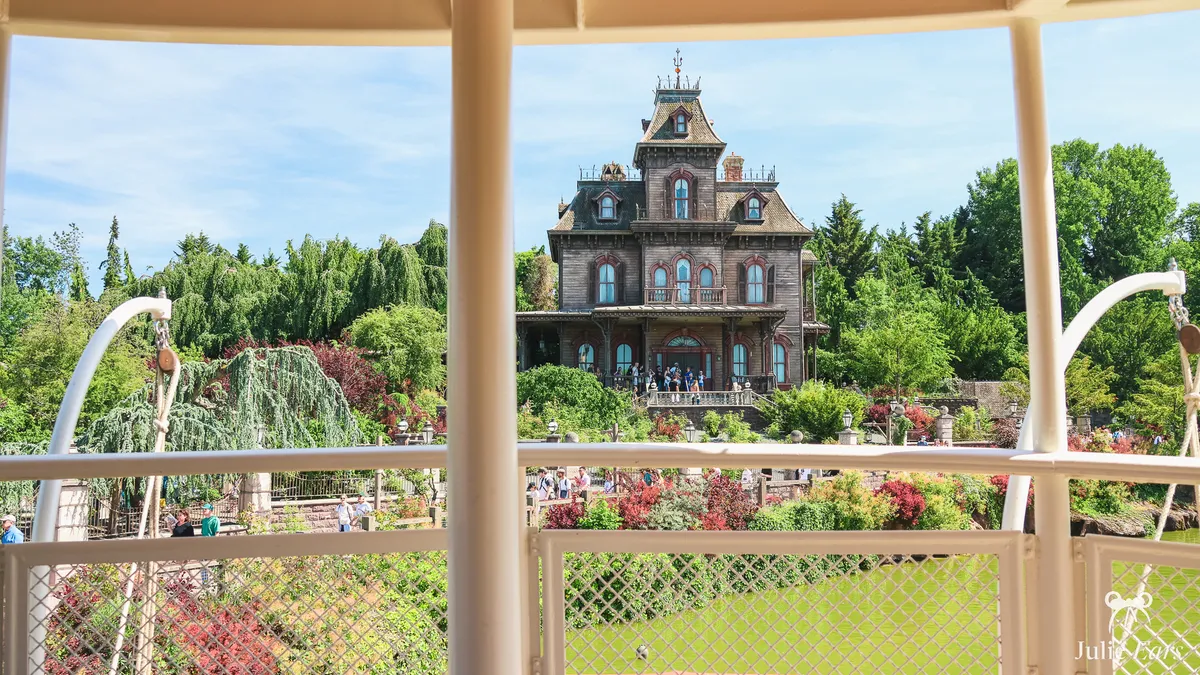
The official version, as it’s told today, is chilling: the Phantom, the menacing narrator who rules over the mansion, is Henry Ravenswood himself. To keep his daughter by his side, even beyond death, he poisoned Melanie’s suitors one after another.
Four men courted her, four men died. After so much waiting and losing the people she loves, Melanie descends into madness and wanders the corridors for eternity, in her wedding dress, bouquet in hand.
The Phantom’s identity was kept secret for a long time. For years, the ride deliberately kept things ambiguous. It was the major refurbishment of 2018 that clarified this tale and made it official.
To visit the mansion (queue, how the ride works, access tips), it’s all on the ride page: Phantom Manor.
Melanie’s four suitors and their fate
The four suitors all have a trade linked to the economy of Thunder Mesa, and their names are American-style puns, each one hinting at a death to match their trade (the dark humour the Imagineers love). Their fates can be guessed in the mansion’s Music Room and Crypt.
| Suitor | His trade and his fate |
|---|---|
| Barry Claude | Oilman, eaten by a bear and her cub. |
| Sawyer Bottom | Owner of the Thunder Mesa sawmill, tied to a log and cut in half by his own circular saw. |
| Captain Rowan D. Falls | Riverboat captain, who went over a waterfall in a rowing boat. |
| Ignatius "Iggy" Knight | Dynamite maker who supplied the mine, killed in an explosion deep inside Big Thunder Mountain. |
The story of the Thunder Mesa Riverboat: the boat that ties it all together
At the height of Thunder Mesa’s success, its wealth draws trade and travellers. That’s how an elegant landing stage appears, the Thunder Mesa Riverboat Landing, along with two paddle steamers sailing the Rivers of the Far West: the Mark Twain and the Molly Brown.
Their names are no accident. The Mark Twain pays tribute to the author of Tom Sawyer (real name Samuel Langhorne Clemens), whom Walt Disney had admired since childhood. The Molly Brown is named after "the unsinkable" Molly Brown, a survivor of the Titanic, and takes the shape of the paddle steamers that travelled up the rivers of the West during the gold rush.
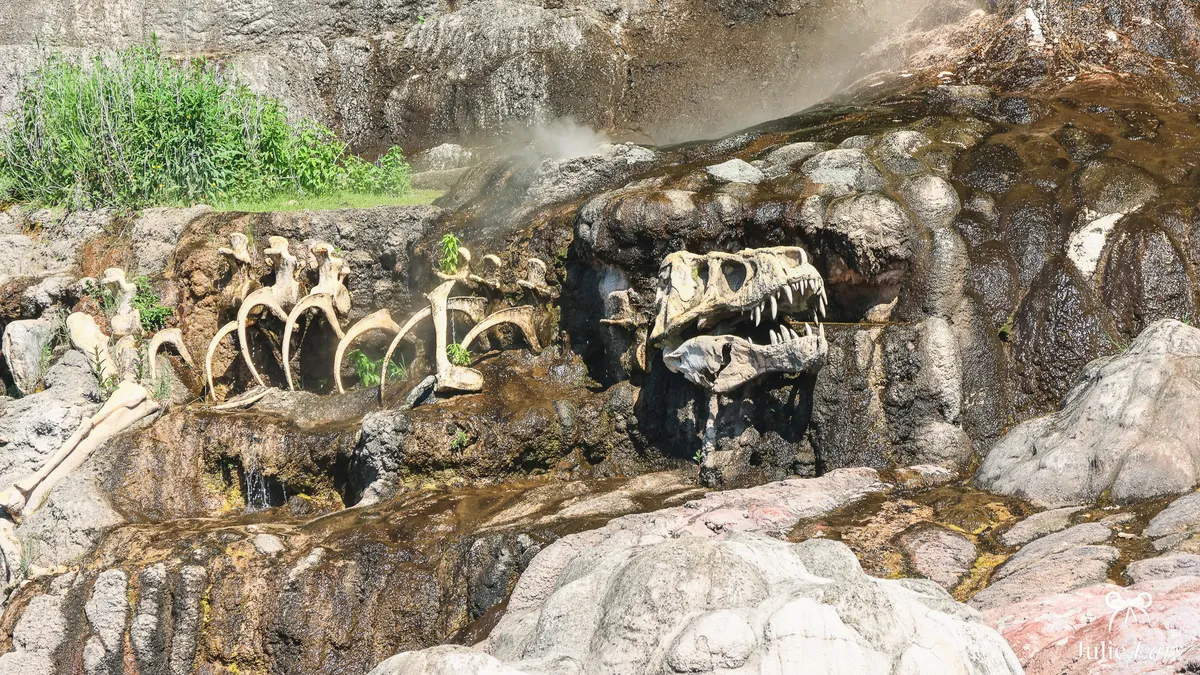
From the deck, the cruise circles the island and gives you the best overall view of Thunder Mesa: the mountain on one side, the Ravenswood mansion perched on its hill on the other and, all around, the river scenery (an old fisherman asleep, Yellowstone-style geysers, dinosaur bones). The boat is the viewpoint that makes you realise the three places belong to the same world.
For the cruise in practice (and the boat actually in service), see the Thunder Mesa Riverboat page. Good to know: new animated scenes (bison, raccoons and other prairie animals inspired by Marc Davis’s drawings) have been added all around the Rivers of the Far West, to spot from the deck of the Molly Brown. The landing stage (Thunder Mesa Riverboat Landing) is still open.
How do the three stories fit together?
Here’s the heart of the tale, the part that turns three rides into a single saga. The gold of Big Thunder Mountain makes Henry Ravenswood’s fortune. That fortune lets him build the town of Thunder Mesa and the mansion on the hill. But blasting the mine with dynamite desecrates the mountain and awakens the Thunderbird. Its anger causes the earthquake of 1860, which kills Henry and Martha.
Henry then returns as the Phantom to haunt the mansion and condemn Melanie to an endless wait. Robbed of its founders and its gold, the town declines and empties. And the Riverboat now sails through these haunted ruins.
One fury, three fates. Together, the mountain, the mansion and the boat tell the rise, the heyday and the fall of Thunder Mesa.
Gold is found: Henry Ravenswood strikes the seam in Big Thunder Mountain and founds the Thunder Mesa Mining Company. The town of Thunder Mesa springs up soon after.
The heyday: Thunder Mesa thrives. The landing stage and the Riverboat arrive on the river, and the mansion rises on Boot Hill.
The desecration: The gold runs low. Dynamite digs into the mountain and awakens the Thunderbird’s anger.
The earthquake: The earthquake destroys the mine, swallows part of the town into a canyon and kills Henry and Martha Ravenswood.
The haunted trains and the mansion: The locomotives race round the mountain on their own, with no driver. Henry returns as the Phantom, and Melanie waits for eternity in her wedding dress.
The abandoned town: Thunder Mesa is deserted. The Riverboat sails through the haunted ruins.
The characters of Thunder Mesa
| Character | Their role |
|---|---|
| Henry Ravenswood | Prospector born in 1795, who discovered the gold, founded Thunder Mesa and owned the Big Thunder Mountain mine. Killed in the earthquake of 1860, he comes back as the Phantom to stop his daughter from ever marrying. |
| Martha Ravenswood | His wife, born in 1802, who died with him in the earthquake. |
| Melanie Ravenswood | Their only daughter, born in 1842. A jilted bride who wanders the manor in her wedding dress, bouquet in hand, before sinking into madness. |
| The Phantom | The menacing narrator who rules over the manor, long left ambiguous, then revealed to be Henry Ravenswood himself. |
| The Thunderbird | The thunderbird of Native American folklore, a giant bird guarding the gold and silver, which unleashes lightning and earthquakes with a beat of its wings. The common cause of the whole disaster. |
Behind the scenes: how Thunder Mesa was really built
So much for the imaginary tale. Now for the other side of the scenery, because the real story of Thunder Mesa is just as interesting. All three rides opened with the park, on 12 April 1992 (the park was then called Euro Disneyland). That makes it stand out: Big Thunder Mountain is the only one of the four Big Thunder mountains in the world to have opened on its park’s very first day.
Behind this corner of Frontierland there’s a team: the Imagineers of Walt Disney Imagineering, led by Tony Baxter, the executive designer in charge of adapting the great Disney classics to the tastes of a European audience.
Rather than copying the American versions, Baxter and his team decided to link all the Frontierland rides to the same story setting: the town of Thunder Mesa, an idea that draws on the concepts of a project dreamed up years earlier by the legendary Imagineer Marc Davis. The aim: for the mountain, the mansion and the river to tell one consistent story.
This approach is what makes the Paris Frontierland different from (and, for many, more accomplished than) its American cousins.
To place Frontierland in the wider history of the park (its construction, its lands, how it has changed), head to the history of Disneyland Paris. You can also read the story of Space Mountain, the park’s other big mountain, or take a step back with the Disney parks around the world.
Phantom Manor: an idea born at the beginnings of Disneyland
The idea of a haunted house in a Disney park is much older than the Paris park: it goes back to the beginnings of Disneyland in California. At the time, Walt Disney talked about a "retirement home for ghosts", an idea dreamed up as early as 1951.
In 1952, Imagineer Harper Goff drew a first version, already tied to the idea of the Old West. In 1953, Sam McKim drew the building, and the ride took the name Haunted Mansion, which became final in 1957.
When the Imagineers designed Phantom Manor for Paris, they went back to these early versions, and in particular to Harper Goff’s drawing inspired by the grand American homes of the second half of the nineteenth century. So Phantom Manor isn’t a copy of the American Haunted Mansion: it’s a cousin, built on the same roots but anchored in its own Western world.
What inspired the mansion
- The architecture is inspired by the Fourth Ward School in Virginia City (Nevada), a town born of the Comstock Lode gold and silver rush, a setting very close to Thunder Mesa. Victorian style (wooden cladding, several storeys, porch) with Second Empire touches: a mansard roof with dormer windows and a square central tower.
- A persistent rumour says the facade was inspired by Norman Bates’s house in Psycho (Hitchcock, 1960). It isn’t true: the Harper Goff drawing the Imagineers worked from predates the film.
- The character and the story draw on reworked European sources, especially Gaston Leroux’s The Phantom of the Opera (1910) and the Addams Family, with influences from Charles Dickens, Washington Irving and Edgar Allan Poe.
- The Portrait Gallery is inspired by Walter Scott’s novel The Bride of Lammermoor.
- The name "Le Manoir des Fantômes" was considered, but the Imagineers wanted an American ring to it, so it became "Phantom Manor".
The ride, scene by scene
Before you even go in, the facade sets the tone: it’s the only Haunted Mansion in the Disney parks with a Western theme and the only one deliberately made to look run-down. The illusion of wear is reinforced by duller colours on the right-hand side, where bad weather in the West most often comes from (the east).
In the gardens, everything speaks of neglect: weeping willows, cypresses, leaning trees, a bandstand, haunting music on a loop, candlelight and silhouettes at the windows (including Melanie, a candle in her hand).
The three introduction scenes
The Foyer (which gets its chandelier back once the doors close), the Secret Room (sliding wall and transformations) and the Portrait Gallery (changing paintings). Since the renovation, this is where you hear Melanie’s voice.
The Grand Staircase
A storm rumbles behind the bay window. The Ravenswood servants invite you to board the Doom Buggies.
The Corridor
Melanie appears in an endless hallway, doors bend, a clock strikes thirteen, an unsettling tapestry hangs on the wall. All these features have been there since the opening in 1992.
The Music Room
A sinister version of Wagner’s Wedding March. The funeral wreaths of the four suitors were added in 2018.
The seance
Madame Leota, a head floating in a crystal ball, summons the spirits. A scene shared by every Haunted Mansion.
The Ballroom
From the top of the staircase, Melanie watches a ghostly party. The organ is a faithful copy of the one in the Haunted Mansion in California, itself inspired by Captain Nemo’s organ in 20,000 Leagues Under the Sea (Disney, 1954).
The Crypt
The Phantom points to a freshly dug grave, then you go down into an underground passage full of animated skeletons, to the sound of "Grim Grinning Ghosts". It now holds the tombs of the four suitors.
Phantom Canyon
The grand finale, a "ghost" version of the town of Thunder Mesa, packed with Audio-Animatronics: a bank robbery, a skull-headed mayor, an apothecary who transforms after one of his own potions, a poker game between invisible players in a ruined saloon. One last appearance by Melanie in a hall of mirrors comes just before the return to the land of the living.
The technology: Doom Buggies, illusions and animatronics
The Phantom Manor ride vehicles are called Doom Buggies. They use the Omnimover system, dreamed up by the Imagineers in the 1960s and developed by WED Enterprises (the former name of Walt Disney Imagineering). Here’s how it works: a chain of cars moving continuously, each one turning up to 180° in a pre-programmed direction, with a wraparound shell that frames your view like a camera.
That’s what lets the Imagineers show you exactly what they want, at the precise moment they want.
The figures that come to life in the mansion and in Phantom Canyon are Audio-Animatronics: robots that reproduce human movements using electronic animation and hydraulic motion. This Disney technology first appeared at the 1964 World’s Fair.
The voices and music of the mansion
The narration of Phantom Manor has a story all of its own. The Phantom’s original voice belongs to Vincent Price, the horror actor many people know from Michael Jackson’s Thriller video (1982). But an agreement with the French authorities required the narration to be mostly in French. So when the ride opened, it was Gérard Chevalier (who had already voiced other attractions, including the Disneyland Railroad) who spoke, and for a long time all that remained of Vincent Price was his maniacal laugh.
Since the renovation, the narration has been bilingual: you finally hear Vincent Price’s English recording, alongside a French version recorded by Bernard Alane (the voice of Clopin in The Hunchback of Notre Dame).
Melanie, for her part, never says a word: her character only ever vocalises. The theme song of every Haunted Mansion, "Grim Grinning Ghosts" (lyrics by Xavier Atencio, music by Buddy Baker, the same pair who wrote "Yo Ho Ho" for Pirates of the Caribbean), comes from an a cappella recording made on 17 February 1969, remastered into a jazzy soundtrack.
As for the manor’s background music, it was composed by John Debney, echoing Camille Saint-Saëns’s Danse macabre, and recorded at Abbey Road Studios in London with the London Chamber Orchestra. The most sinister sounds were worked on with Skywalker Sound.
Whenever I go on a ride, I always think about how I could make it better.
The 2018 refurbishment
The big turning point for Phantom Manor was its refurbishment in 2018. The aim: to clarify and strengthen the story of Melanie and the narrator, and to add scenery, illusions and new features. It’s this version that officially confirms the Phantom is Henry Ravenswood.
On the creative side, the work was overseen by Tom Fitzgerald (creative director and executive producer) and Imagineer Daniel Joseph (special effects and illusions, an expert on Yale Gracey’s work). At Disneyland Paris, art director Beth Clapperton and show design manager Bjørn Heerwagen led the project, in a spirit of collaboration between American Imagineers and French teams.
Several hundred workers and craftspeople (painters, set decorators, lighting technicians, carpenters, robotics engineers, sculptors), many of them local, worked on this refurbishment.
- A new introduction (Foyer and Portrait Gallery) featuring Melanie’s voice.
- The funeral wreaths of the four suitors added to the Music Room.
- A Crypt that now houses the tombs of the four suitors.
- Bilingual narration, with Vincent Price’s voice restored and Bernard Alane’s new French version.
- New paintings for the Portrait Gallery.
- A meet and greet area with Disney characters near the bandstand, with a Victorian-Western Mickey costume made by the costume workshop.
Phantom Manor in the Haunted Mansion family
Phantom Manor may stand apart, but it belongs to a big family of Disney rides. It picks up many of their nods (the singing busts, Madame Leota, the clock that strikes thirteen, the wallpaper), while remaining the only version set in a Western world.
| Ride and park | Special features |
|---|---|
| Haunted Mansion, Disneyland (California) | Opened on 9 August 1969, in New Orleans Square. Atmosphere by Claude Coats, characters by Marc Davis. Neo-Gothic building. |
| Haunted Mansion, Walt Disney World (Florida) | Dedicated on 1 October 1971, in Liberty Square. Antebellum-style building. |
| Phantom Manor, Disneyland Paris | Opened in 1992, in Frontierland. The only version rooted in the Wild West, with a proper official backstory (the Ravenswoods). |
| Mystic Manor, Hong Kong Disneyland | A variation with Lord Henry Mystic and Albert the monkey, in Mystic Point. No ghosts in the classic sense. |
Hidden details and secrets of Thunder Mesa
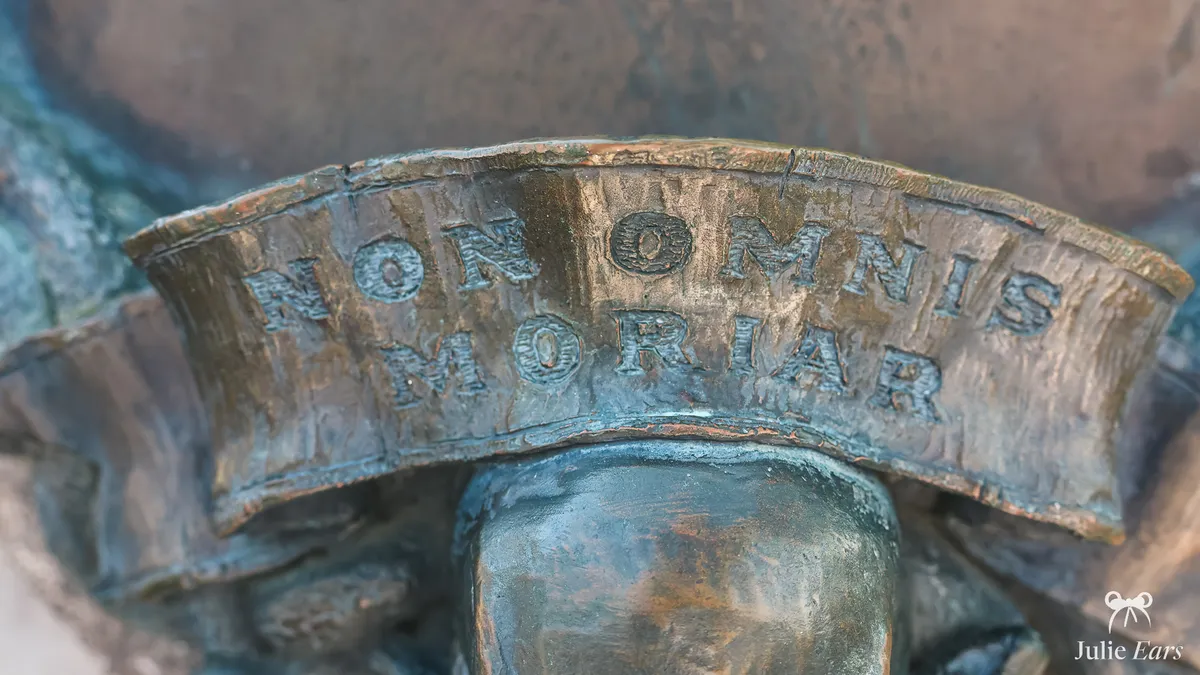
- The manor’s motto, engraved at the entrance on a plaque with intertwined snakes: "Non Omnis Moriar", Latin for "I shall not wholly die" (a quotation from Horace). Quite a statement for a family that refuses to leave this world, and a warning from the Phantom.
- On the facade, Melanie sometimes appears at a window, candle in hand, moving from one room to the next: a living detail that few visitors notice.
- The Ravenswood manor can be seen from the mountain train AND from the Riverboat deck: the three places were deliberately designed as a single whole.
- On board Big Thunder Mountain, look out for the animated scenes: a goat tugging at a shirt on a washing line, tethered donkeys braying as the trains go by and dynamite smoking on the last climb. All nods to the mining town. The Thunderbird itself is hidden in the rock: to spot it, look down on the bend just before you enter the mine, at the moment of the explosion that follows the earthquake.
- The washing drying on the line, at the start of the train’s second climb, belongs to Catfish Joe, an old fisherman who lives with his dog on the other side of the mountain. You’ll actually spot him fishing when you sail round the lake aboard the Molly Brown: the same character turns up on two attractions, proof that the whole of Thunder Mesa is one single setting.
- The mountain’s animals have names chosen as a nod: the two donkeys are called Beth and Bjørn, and the billy goat Yon, in tribute to Beth Clapperton and Bjørn Heerwagen, two leads of the design team (you’ve already come across their names above, in the 2018 renovation).
- The town’s businesses recall its mining past: Fort Comstock at the entrance, the Thunder Mesa Mercantile Building and the Lucky Nugget Saloon (founded in 1858 by Miss Diamond Lill). The signs carry on the mining theme: Lucky Nugget speaks for itself, the Silver Spur Steakhouse refers to silver, and the Eureka Mining Supplies shop takes its name from the "Eureka" shouted on finding a nugget.
- Boot Hill, the hill overlooking Thunder Mesa, is home to both the manor and the town cemetery: a typical cemetery name in the American West.
- The character of Master Gracey, in the manor, pays tribute to Imagineer Yale Gracey, the master of ghost illusions.
- The mystery over the Phantom’s identity was kept up on purpose for years, from the opening in 1992 until the 2018 renovation.
Thunder Mesa is also full of wider nods shared across the whole park. For the famous Hidden Mickeys (those Mickey silhouettes tucked away everywhere), see my guide to the Hidden Mickeys. And for the other secrets scattered around Disneyland Paris, take a look at the secrets of Disneyland Paris.
If you like this kind of behind-the-scenes story, other backstories in the series might interest you: the backstory of Pirates of the Caribbean, the Tower of Terror one or the Indiana Jones one.
Frequently asked questions
01 Is there a minimum age for Phantom Manor, the haunted mansion?
No, Phantom Manor has no minimum age and no minimum height: everyone can ride it. It’s a gentle, dark ride with a mysterious atmosphere, but without anything truly frightening or any big thrills. Very young children who are sensitive to the dark may find it a little scary, so it’s your call.
02 What year did Big Thunder Mountain and Phantom Manor open at Disneyland Paris?
Both rides opened on the park’s opening day, 12 April 1992 (the park was then called Euro Disneyland). Big Thunder Mountain has the distinction of being the only one of the world’s four Big Thunder mountains to have opened on its park’s very first day.
03 Who is the Phantom of Phantom Manor?
Since the refurbishment, the official version reveals that the Phantom is Henry Ravenswood, Melanie’s father. Back from the dead, he poisoned his daughter’s suitors one after another to keep her by his side. The mystery over his identity was kept up on purpose for years, from the opening in 1992 until the refurbishment.
04 What is the story of Big Thunder Mountain at Disneyland Paris?
Big Thunder Mountain tells the story of a mountain in the American West full of gold and silver, guarded by the Thunderbird, a spirit from Native American folklore. Prospectors strike gold there in 1853, but when dynamite desecrates the rock, the Thunderbird wakes up and unleashes its fury. The earthquake of 1860 destroys the mine and the town. Since then, the locomotives have raced round the mountain on their own, with no driver. The runaway mine train you ride is this curse in action.
05 Do Big Thunder Mountain, Phantom Manor and the Riverboat tell the same story?
Yes. All three attractions belong to the fictional town of Thunder Mesa, a deliberate choice by Tony Baxter’s Imagineers. The mountain’s gold makes Henry Ravenswood’s fortune, and he builds the town and the manor. The desecration of the mountain wakes the Thunderbird, whose fury causes the earthquake of 1860 that kills the Ravenswoods and dooms the town. The Riverboat, for its part, sails round the river and lets you see all these places together.
06 What are the secrets and hidden details of Thunder Mesa?
Among the most striking: the Latin motto "Non Omnis Moriar" carved at the entrance to the manor ("I shall not wholly die", from Horace), Melanie appearing at a window on the facade with a candle in her hand, the manor visible both from the train and from the boat, and the animated scenes of Big Thunder Mountain (the goat, the donkeys, the smoking dynamite). For Hidden Mickeys and secrets from across the park, see the dedicated articles.


