



Space Mountain is the ride that sent Disneyland Paris into orbit in 1995 and it’s probably the one with the richest history in the whole park.
Over thirty years, it has told three different stories under the same dome. First came De la Terre à la Lune (1995-2005), inspired by Jules Verne’s novel and its giant cannon. Then Mission 2 (2005-2017), a journey beyond the galaxy. Today it’s Star Wars Hyperspace Mountain (since 2017), which drops you into the Battle of Jakku.
Behind this launched coaster in the dark lies a family tree that goes back to 1959 and to Walt Disney’s own dream of space. In this article, I take you through how it all began, what went on behind the scenes of the three versions, the full backstory of the Baltimore Gun Club and plenty of stories for fans. If you’re after practical information instead (queue, height requirements, thrill level), it’s all on the Star Wars Hyperspace Mountain page.
How it began: from the Matterhorn to Walt Disney’s dream of space
To understand Space Mountain, you have to go back to 1959. On 14 June that year, Disneyland in California opened Matterhorn Bobsleds, a 1/100 scale replica of the Matterhorn.
The idea was born in 1958, while the film Third Man on the Mountain was being shot in Zermatt. Walt Disney sent a postcard of the peak to his Imagineers (Disney’s creative engineers, a blend of "imagination" and "engineer") with an instruction of just two words: "Build it!".
This ride laid the technical groundwork that would make Space Mountain possible. It was the first rollercoaster with a tubular steel track, more flexible and safer, able to send several vehicles at once along two interlocking tracks and, above all, to run part of the ride indoors. Arrow Development designed its track system, and years later Disney called on the same company again to design the tracks of Space Mountain. A Yeti and ice scenery were added in 1978.
Build it!
Walt Disney, on the back of a Matterhorn postcard sent to his Imagineers (1958)
Walt Disney was fascinated by space exploration long before the first crewed flights. Between 1955 and 1957, his TV series Disneyland aired three episodes on the subject: Man in Space, Man and the Moon and Mars and Beyond.
It was against this backdrop that, at the end of 1964, Walt came up with a new idea with designer John Hench, on the advice of science fiction author Ray Bradbury: the first launched rollercoaster in complete darkness, which would be the heart of a "Space Port" in Tomorrowland.
The original plan had four tracks, part of them outdoors. The technology wasn’t ready, and it would take computers to calculate such a complex layout and control the rocket launches safely.
The project then lay dormant for more than ten years. Walt Disney’s death in 1966, then the priority given to building Disney World in Florida, pushed it back. It was only revived after Magic Kingdom opened in 1971, when its unexpected success with teenagers and young adults finally convinced Disney to build this space coaster.
On 15 January 1975, Space Mountain finally opened at the Magic Kingdom in Florida. It was Edna Disney, Walt’s sister-in-law and Roy O. Disney’s widow, who opened it at the age of 84. Its conical shape, designed by John Hench, is often compared to Mount Fuji.
A smaller single-track version then opened in California on 27 May 1977, opened by six of the seven original Mercury astronauts. This version was later copied at Tokyo Disneyland (1983) and then Hong Kong (2005). For the 50th anniversary of the Disneyland Resort, it reopened in the presence of Neil Armstrong, with a plaque bearing a line Walt was fond of.
It’s kind of fun to do the impossible.
Walt Disney
Jules Verne, the Columbiad cannon and Discoveryland
At Disneyland Paris, Space Mountain isn’t in a future-facing "Tomorrowland" as in the other parks, but in Discoveryland, which opened with the park in 1992. This land (a themed area of the park) pays tribute to the great visionaries, and above all to Jules Verne and his publisher Hetzel, who published his Voyages Extraordinaires.
You’ll spot these nods everywhere: Le Visionarium (now Buzz Lightyear Laser Blast), Orbitron, Café Hetzel and even a mural dedicated to the author at the annual pass office.
Walt Disney and Jules Verne had a lot in common: both were self-taught visionaries. A quote attributed to Verne, which Walt liked to repeat, sums up this spirit well.
Anything one man can imagine, other men can make real.
Quote attributed to Jules Verne, a favourite of Walt Disney
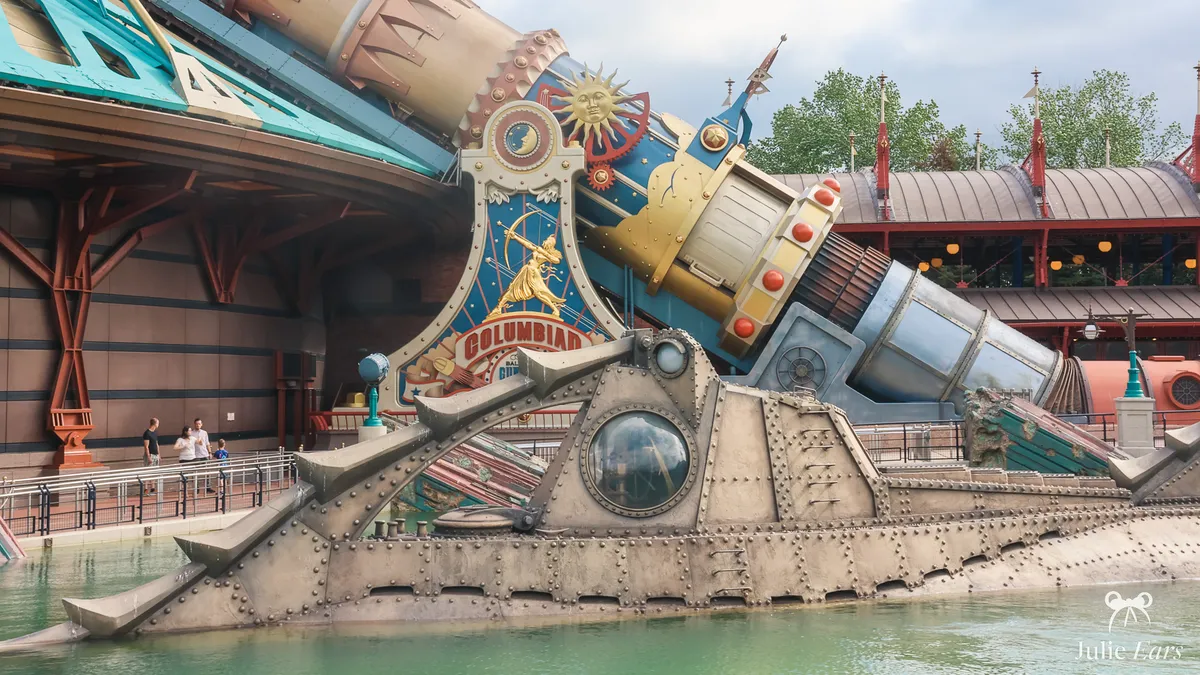
The Paris version of Space Mountain is directly inspired by Jules Verne’s novel De la Terre à la Lune (From the Earth to the Moon, 1865). In the story, the Baltimore Gun Club, a club of artillerymen, builds a giant cannon called the Columbiad to send a crewed projectile to the Moon. It’s this cannon, reproduced to scale, that stands in front of the ride’s entrance and sets up the whole story.
In front of the dome, in the lagoon, you’ll also come across the Nautilus submarine from Les Mystères du Nautilus, another tribute to Verne.
Discovery Mountain, the forgotten working title
Before it became Space Mountain, the project had another name: Discovery Mountain. The ambition went far beyond a single ride. The Imagineers pictured a whole complex with several attractions and a restaurant under one roof, themed on "Fire and Water". The centrepiece wasn’t even a rocket but the Nautilus, from Twenty Thousand Leagues Under the Seas.
One version even had two rollercoasters side by side: a family "junior coaster" and a "senior coaster" closer to the American Space Mountain, with part of the track outdoors. The project was dropped because it was too complex and took up too much space.
Version 1: De la Terre à la Lune (1995-2005), the original
Construction began in 1993, for an opening two years later. Inaugurated on 31 May 1995 (and opened to the public the next day, 1 June), this first version carried straight on from Verne’s novel. After their journey to the Moon, the members of the Gun Club, president Impey Barbicane, Captain Nicholl and the Frenchman Michel Ardan, had founded the "Blue Moon Mining Company". The club now offered anyone the chance to make the same trip to the Moon.
You got in either by a bridge running alongside the Discovery Lagoon, near the cannon, or by "La Voie Stellaire", a walkway opposite the Videopolis Theater that would later become the FastPass entrance.
The industrial-style boarding hall was decorated with French flags in tribute to Michel Ardan, the novel’s French hero. After the boarding announcement, the rocket train was catapulted into the cannon with a bang and smoke, a nod to the "400,000 pounds of gun-cotton" mentioned by Verne. The motto of the journey: "Ad Luna in flamma gloria!".
On the way, a "wandering body" (an asteroid) knocked the trajectory off course, just like in the novel, with a tribute to Georges Méliès’s Moon with a human face (A Trip to the Moon, 1902). The final braking was handled by the "Electro-De-Velocitor", an electrical device reminiscent of the Nautilus, before a triumphant return to a fanfare.
One of the big choices for this version was an on-board soundtrack synchronised with the ride, by composer Steve Bramson. He had worked on Tiny Toon Adventures and The Young Indiana Jones Chronicles, alongside James Horner.
His grand theme draws on two influences quoted in the book: Claude Debussy, for the impressionistic, mysterious side, and Gustav Holst, whose suite The Planets brings the sweeping scale. The music was prepared in a studio in California, fine-tuned during two trips to Paris, then recorded in Los Angeles with around sixty musicians.
When it opened, the ride claimed several world firsts: the first launched rollercoaster in the dark to combine a catapult start, inversions and a synchronised onboard soundtrack. In 1996, it won the award for best attraction from the TEA (Themed Entertainment Association), a benchmark in the theme park industry.
Michael Eisner, then CEO of Disney, even credited the ride (and its designer, Imagineer Tim Delaney) with helping to save Disneyland Paris: its success supported the financial recovery of the resort, which was in serious trouble at the time.
The 1995 opening night brought together an unexpected cast: an actor playing Jules Verne, perched in his barrel on the cannon, but also Buffalo Bill, Annie Oakley, Elton John and astronaut Buzz Aldrin.
On 7 October 1995, 500 young Europeans gathered at Videopolis even spoke live with the Russian MIR space station. Collectors, for their part, kept the pins, the 20th anniversary medal and the certificate given to children too small to ride.
Version 2: Mission 2 (2005-2017), to the Moon and beyond
For the ride’s 10th anniversary, Space Mountain got a new storyline on 9 April 2005 and became Space Mountain: Mission 2. Work on the idea had started in early December 2003. This time the journey no longer stops at the Moon: the "explornauts" head beyond the galaxy to discover the wonders of the Universe. The track and the sets were reworked, and a new "Supernova" logo came with the change.
The opening night had an electro feel and was hosted by DJ Tiësto, with actor Vin Diesel in attendance.
The 2015 refurbishment
In 2015, Disneyland Paris launched a plan to refurbish ten iconic attractions ahead of its 25th anniversary. Space Mountain was one of them: the dome was repainted, the roof, the cornice and the Columbiad sign were restored, the star and supernova projections switched entirely to LED, and the train control system (the "ride control") was modernised.
This was also when the Single Rider queue appeared, for visitors travelling on their own.
The ride reopened, still as Mission 2, on 27 July 2015, twenty years after it first opened.
The 3rd version: Star Wars Hyperspace Mountain (2017-2027)
On 7 May 2017, as part of the Season of the Force, Space Mountain took on its current form: Star Wars Hyperspace Mountain. The story moved into the Star Wars universe.
You’re thrown into the Battle of Jakku, which pits the New Republic against the last of the Empire, one year after the Battle of Endor. The story features Admiral Ackbar, a Star Destroyer, TIE fighters up against Blue Squadron and, of course, a jump to hyperspace.
This version is the natural next step after Mission 2 and the 2015 refurbishment. It took twelve months of design and four months of installation.
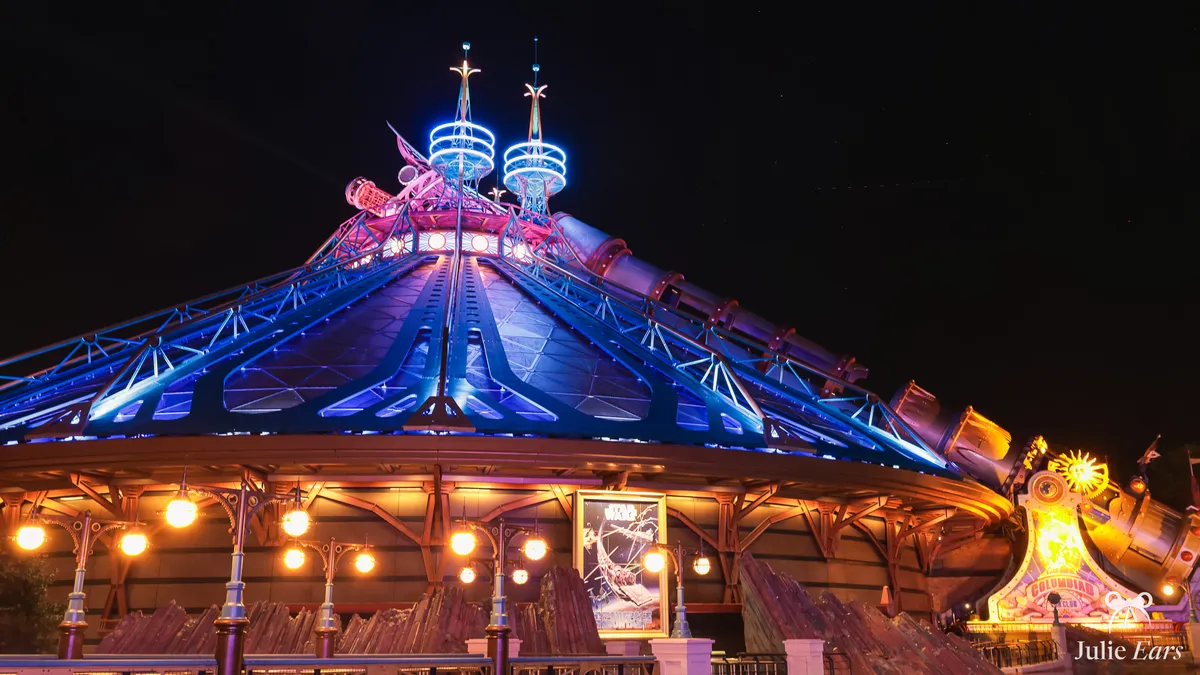
The switch to Hyperspace Mountain wasn’t just a new coat of paint. New effects were added: lasers and projections on nine screens along the ride. The rocket trains were replaced by models with a lower centre of gravity, with new restraints for better stability, and the minimum height was lowered to 1.20 m.
The soundtrack was also redone, using extracts from the music of the Star Wars films.
For the decor, the original copper tones made way for a sky blue, with "cannon" details (gears, suns, stars) and the goddess Diana shown on the restraints. Before each opening, the ride is tested with weighted cars.
Version 4: the return of De la Terre à la Lune (announced in 2026)
At D23 2026, Disney announced that Space Mountain will get its original theme back, De la Terre à la Lune. The Star Wars Hyperspace Mountain version is due to close at the end of 2027, then the ride will return to the world of Jules Verne after a period of construction work. A return to its roots, more than thirty years after it first opened in 1995. I’ve covered the announcements in detail in my D23 2026 recap.
The versions compared
| Ride version | Period | Storyline | Theme |
|---|---|---|---|
| De la Terre à la Lune | 1995-2005 | The Baltimore Gun Club fires you to the Moon | Jules Verne |
| Mission 2 | 2005-2017 | A journey beyond the galaxy with the explornauts | Disney science fiction |
| Star Wars Hyperspace Mountain | since 2017 | The Battle of Jakku after Endor | Star Wars |
Matterhorn Bobsleds
Disney’s first "mountain" opens in California and lays the technical groundwork.
Space Mountain Florida
The first Space Mountain opens at Magic Kingdom, inaugurated by Edna Disney.
California version
A single-track version opens at Disneyland, inaugurated by Mercury astronauts.
De la Terre à la Lune
The Paris ride inspired by Jules Verne is inaugurated (it opens to the public on 1 June).
Mission 2
A new storyline beyond the galaxy for the 10th anniversary.
Renovation
The ride reopens after a complete refurbishment, still as Mission 2, and gains a Single Rider queue.
Hyperspace Mountain
The ride switches to the Star Wars world with the Battle of Jakku.
Fun facts and secrets for fans
- The French flags in the original boarding hall paid tribute to Michel Ardan, the French hero of Verne’s novel.
- Diana, the Roman goddess of the Moon and the hunt, appears on the harnesses of the current version, a discreet nod to the original lunar theme.
- The Moon with a human face in the De la Terre à la Lune version paid tribute to Georges Méliès’s film A Trip to the Moon (1902).
- Neil Armstrong, the first man to walk on the Moon, took part in the reopening of the California version for Disneyland Resort’s 50th anniversary.
- It was Edna Disney, Walt’s sister-in-law, who opened the very first Space Mountain in Florida at the age of 84.
- Space Mountain’s conical silhouette, designed by John Hench, is often compared to Mount Fuji.
Space Mountain is just one piece of the park’s wider story. If the subject fascinates you, you can carry on with the creation of Disneyland Paris in 1992 and explore the full history of Disneyland Paris. For ride backstories, I recommend the Thunder Mesa saga, the story world behind Big Thunder Mountain and Phantom Manor.
And to plan your own trip under the blue dome, you’ll find all the practical information (queue, height requirements, thrill level, Single Rider) on the Star Wars Hyperspace Mountain page.
Frequently asked questions
01 What are the different versions of Space Mountain at Disneyland Paris?
Since 1995, Space Mountain has had three versions under the same dome. De la Terre à la Lune (1995-2005), inspired by Jules Verne’s novel, catapulted you to the Moon with the Baltimore Gun Club. Mission 2 (2005-2017) offered a journey beyond the galaxy. Since 7 May 2017, the ride has been Star Wars Hyperspace Mountain, which throws you into the Battle of Jakku.
02 What was De la Terre à la Lune, the first version?
It was the original 1995 version, directly inspired by Jules Verne’s novel De la Terre à la Lune. The story carried on from the book: the Baltimore Gun Club offered everyone a trip to the Moon aboard a rocket train fired from a giant cannon, the Columbiad. The ride featured an asteroid knocking you off course and an on-board orchestral soundtrack by Steve Bramson.
03 What is the minimum height for Star Wars Hyperspace Mountain?
The minimum height to ride Star Wars Hyperspace Mountain is 1.20 m. It was lowered to this level when the ride switched to its Star Wars version in 2017, with the arrival of new rocket trains. You’ll find all the practical details on the ride’s page.
04 Is Space Mountain scary?
It’s one of the most intense rides at Disneyland Paris. It has a launched start, runs in the dark and has three inversions (including a full loop). If fast rollercoasters and going upside down aren’t your thing, it can be daunting. For details on the thrills, see the Star Wars Hyperspace Mountain page.
05 Why is Space Mountain linked to Jules Verne?
Because at Disneyland Paris it stands in Discoveryland, a land dedicated to visionaries like Jules Verne. The original version was inspired by his novel De la Terre à la Lune: the Columbiad cannon reproduced in front of the entrance and the Baltimore Gun Club story come straight from it. Even after the theme changes, the decorative cannon has stayed.


