



Even if you’ve never ridden any of these attractions, you can still fall for this tale, and that’s exactly what makes it great. Disney wrote a full, detailed storyline for Frontierland in Paris, spread over three different spots at the same time. I’ll walk you through it like a story, following the official version (Disneyland Paris’s own, which doesn’t always match the other parks).
After that, I’ll take you backstage: who built these rides, how they did it, and under what circumstances. Trust me, once you understand how it all connects, Frontierland will never look the same to you.
The story of Thunder Mesa: the town born of gold
Thunder Mesa is a made-up Old West town sitting below a red mountain in an unforgiving desert. You can sum up its fate in a few words: gold gave it life, and the curse protecting that gold killed it.
In the middle of the nineteenth century, prospectors make their way into the region in search of ore.
The discovery of a rich vein of gold in Big Thunder Mountain sets off a rush: within a few years, the desert gives way to a lively town, with its Western businesses (the fortified entrance of Fort Comstock, the Thunder Mesa Mercantile Building, the Lucky Nugget Saloon founded in 1858 by Miss Diamond Lill). That’s when the man at the center of it all enters the scene.
Born in 1795, the prospector Henry Ravenswood hits pay dirt in 1853. He sets up the Thunder Mesa Mining Company, takes ownership of the Big Thunder Mountain mine, becomes the wealthiest man around, and Thunder Mesa grows up because of him. Up on Boot Hill, the rise looking down on the town and set aside for its founding families, he has a large Victorian house built and moves in with his wife Martha (born in 1802) and their one and only daughter, Melanie (born in 1842). The town’s graveyard sits on that very same hill, and that’s where the Ravenswoods are buried.
Now you have the backdrop. A booming town, an influential family, a mountain loaded with gold. It all looks like a recipe for success, which is precisely the moment things go wrong.
The story of Big Thunder Mountain: the cursed mountain
Long before anyone came looking for gold, a legend existed. Local Native American folklore says Big Thunder Mountain shelters the Thunderbird, a protective spirit shaped like an enormous bird that keeps watch over the gold and silver buried in the mountain.
Whoever tries to take its riches faces its anger, and with one flap of its wings it can call down lightning and make the ground shake. Henry Ravenswood, for his part, dismissed all of it.
For several years, the mine turns out gold by the ton, and the curse seems like little more than an old superstition. Then the gold starts to dry up. So the miners can keep going, they turn to dynamite and blow their way deep into the rock. This act of desecration rouses the Thunderbird, and the strange happenings return: rumbling from the mountain, runaway ore cars, a mine nobody can control. You get to experience that chaos firsthand on the mine train.
This mountain has a special status at Disneyland Paris. Big Thunder Mountain, nicknamed Le Train de la Mine by many French guests, stands on an island surrounded by the Rivers of the Far West, a spot the other Disney parks generally reserve for Tom Sawyer Island. To get there, you start at a station on the bank and travel through two underwater tunnels out to the island, something you’ll only find in Paris.
It’s also a runaway mine train, in other words a roller coaster themed as a mine gone haywire.
For the practical side (the line, the height requirement, the thrills), everything is on the ride’s page: Big Thunder Mountain. Here, the main thing to remember is that this mountain isn’t just a big roller coaster: it’s the cause of everything that follows. Henry Ravenswood owned its mine, and that’s what ties the mountain directly to the Ravenswood mansion.
The 1860 disaster and the haunted trains
By 1860, the Thunderbird’s rage hits its high point. A huge quake strikes Thunder Mesa, wrecking the mine, dropping a section of the town into a canyon, and taking many lives, among them Henry Ravenswood and Martha, his wife. With no founders left and no more gold, people slowly leave the town behind.
In the aftermath, something odd is reported: the locomotives keep circling the mountain by themselves, with nobody at the controls and no crew aboard, as though something had taken hold of them. This is the origin of the ride you know today: the Big Thunder Mountain Railroad was set up in the former mining camp so visitors could hop on these out-of-control trains and experience the curse for themselves.
And that 1860 quake did more than ruin the mountain: the very same catastrophe is what starts the tale of the Ravenswood mansion.
The story of Phantom Manor: the bride and the Phantom
Perched on its hilltop, the Ravenswood mansion overlooks both the town and the mountain. This is where the grimmest chapter plays out. It also stands out as one of only a handful of Haunted Mansions with a true official storyline, tied to the American West instead of some generic spooky house.
Melanie comes of age in this house as one of the best matches in all of Thunder Mesa, with plenty of suitors lining up. Her father is the issue: Henry can’t bear the idea of her going off with another man.
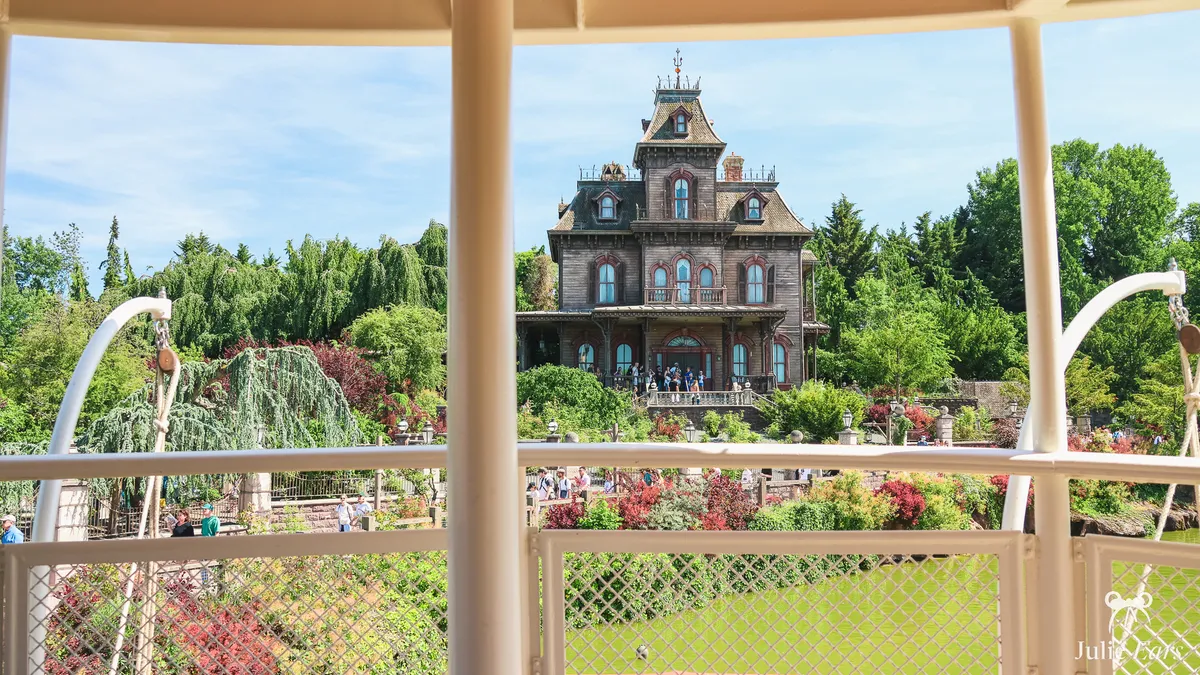
As the official story goes today, the truth is bone-chilling: the Phantom, that sinister voice lording over the mansion, is none other than Henry Ravenswood. Determined to keep his daughter close, even from beyond the grave, he poisoned each of Melanie’s suitors in turn.
Four men courted her, and all four ended up dead. Worn down by waiting and by losing everyone she cares about, Melanie loses her mind and roams the halls forever in her bridal gown, still holding her bouquet.
For a long time, nobody officially knew who the Phantom was. The ride left the question open on purpose for years, and it took the big 2018 refurbishment to settle it and make this version canon.
To visit the mansion (the line, how the ride unfolds, access tips), head to the ride page: Phantom Manor.
Melanie’s four suitors and how they met their end
All four suitors have jobs tied to Thunder Mesa’s economy, and their names are American-style puns, each hinting at a death to match his trade (the dark humor Imagineers love). You can piece together their fates in the Music Room and in the mansion’s Crypt.
| Suitor | His job and his end |
|---|---|
| Barry Claude | Oil man, devoured by a bear and her cub. |
| Sawyer Bottom | Owner of the Thunder Mesa sawmill, tied to a log and sliced in two by his own circular saw. |
| Captain Rowan D. Falls | Captain of a river steamer who plunged over a waterfall in a small rowboat. |
| Ignatius "Iggy" Knight | The man who made the mine’s dynamite, blown up deep inside Big Thunder Mountain. |
The Thunder Mesa Riverboat story: the link between everything
At the height of Thunder Mesa’s prosperity, wealth draws trade and travelers. That’s how an elegant landing, the Thunder Mesa Riverboat Landing, comes to be, along with two paddle steamers plying the Rivers of the Far West: the Mark Twain and the Molly Brown.
Their names were no accident. The Mark Twain pays tribute to the author of Tom Sawyer (whose real name was Samuel Langhorne Clemens), whom Walt Disney had loved since childhood. The Molly Brown is named after the "unsinkable" Molly Brown, a survivor of the Titanic sinking, and takes on the look of the paddle steamers that traveled up Western rivers during the gold rush.
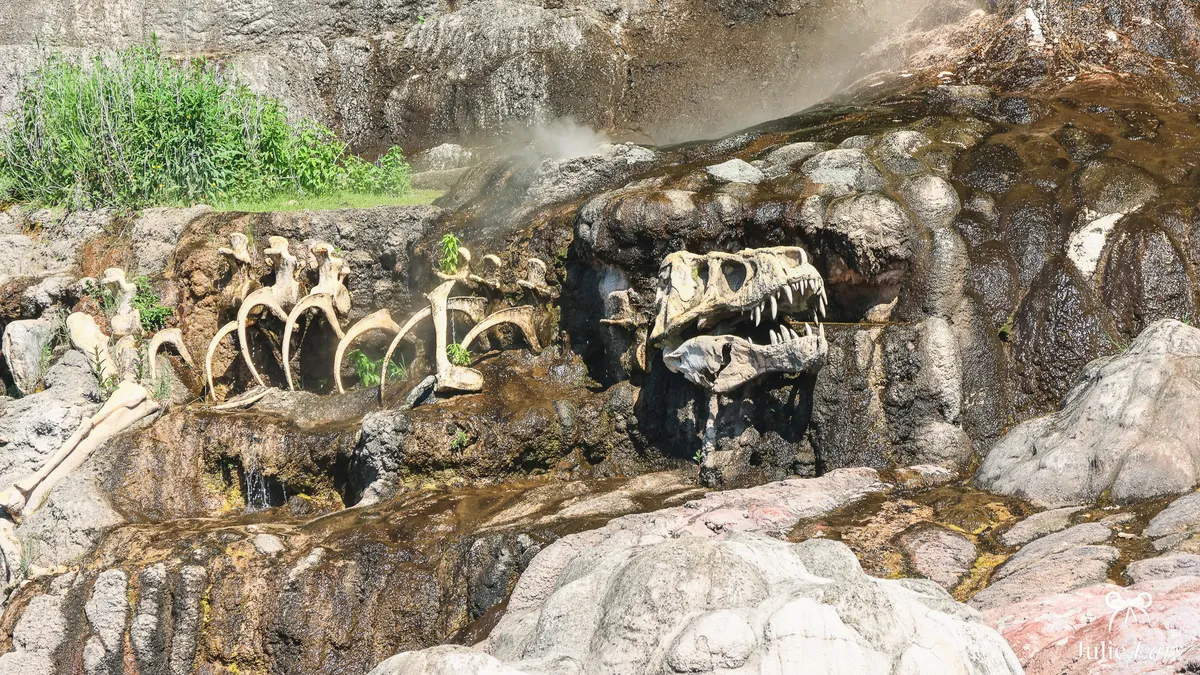
As the boat loops around the island, the deck gives you the clearest panorama of Thunder Mesa there is: the mountain on one bank, the Ravenswood mansion high on its hill on the other, and riverside sets everywhere you look (a sleepy old fisherman, geysers like the ones in Yellowstone, dinosaur skeletons). From the boat, it finally clicks that all three places are part of one world.
For practical info on the cruise (including which boat is currently sailing), see the Thunder Mesa Riverboat page. Good to know: fresh animated scenes (bison, raccoons, and more prairie critters based on Marc Davis’s sketches) now line the Rivers of the Far West, and you can spot them from the Molly Brown’s deck. The Thunder Mesa Riverboat Landing is still open.
How do the three stories fit together?
This is the key that turns three separate rides into one saga. Gold from Big Thunder Mountain makes Henry Ravenswood rich. With that money, he builds Thunder Mesa and his mansion up on the hill. Yet dynamiting the mine desecrates the mountain and wakes the Thunderbird, whose rage sets off the 1860 earthquake that kills Henry and Martha.
Henry comes back as the Phantom, haunting the house and leaving Melanie stuck waiting forever. Without its founders or its gold, the town fades and its people move away. Today, the Riverboat glides past those haunted ruins.
A single burst of rage, three fates sealed. The mountain, the mansion, and the boat, taken together, trace how Thunder Mesa was born, flourished, and collapsed.
Gold is discovered: Henry Ravenswood strikes the lode in Big Thunder Mountain and founds the Thunder Mesa Mining Company. The town of Thunder Mesa springs up right after.
Boom times: Thunder Mesa is flourishing. A boat landing goes up, the Riverboat starts running on the river, and Henry’s mansion rises on Boot Hill.
The desecration: gold grows scarce. Dynamite blasts into the mountain and awakens the Thunderbird’s fury.
The quake: the mine collapses, a chunk of town vanishes into a canyon, and both Henry and Martha Ravenswood lose their lives.
Ghost trains and a haunted house: driverless locomotives circle the mountain by themselves. Henry is back as the Phantom, and Melanie, still in her bridal gown, waits forever.
A ghost town: nobody lives in Thunder Mesa anymore, and the Riverboat drifts past what’s left of it.
The characters of Thunder Mesa
| Character | Role |
|---|---|
| Henry Ravenswood | Born in 1795, this prospector found the gold, founded Thunder Mesa, and owned the Big Thunder Mountain mine. After dying in the 1860 earthquake, he returns as the Phantom so his daughter can never wed. |
| Martha Ravenswood | Henry’s wife, born in 1802, who lost her life alongside him when the earthquake struck. |
| Melanie Ravenswood | The couple’s only child, born in 1842. Left at the altar, she haunts the house in her bridal gown, clutching her bouquet, until her mind gives way. |
| The Phantom | The menacing narrator who rules over the mansion, left ambiguous for years, then revealed to be Henry Ravenswood himself. |
| The Thunderbird | The thunder spirit of Native American folklore, a giant bird guarding the gold and silver, who unleashes lightning and earthquakes with one beat of its wings. The shared cause of the whole disaster. |
Behind the scenes: how Thunder Mesa was really built
So much for the fictional tale. Now I’ll take you behind the scenery, because the real story of Thunder Mesa is just as interesting. All three rides opened with the park, on April 12, 1992 (the park was called Euro Disneyland back then). That’s a notable distinction: Big Thunder Mountain is the only one of the four Big Thunder mountains around the world to have opened on its park’s very first day.
Behind this corner of Frontierland is a team: the Imagineers of Walt Disney Imagineering, led by Tony Baxter, the executive designer tasked with adapting the great Disney classics for European audiences.
Rather than copying the American versions, Baxter and his team chose to link all of Frontierland’s attractions to a single story setting: the town of Thunder Mesa, an idea drawn from concepts for a project dreamed up years earlier by legendary Imagineer Marc Davis. The goal: for the mountain, the mansion, and the river to tell one coherent story.
That creative choice is what makes the Paris Frontierland different from (and, for many, more polished than) its American cousins.
To place Frontierland within the park’s bigger story (how it was built, its lands, how it has changed), head over to the history of Disneyland Paris. You can also read the history of Space Mountain, the park’s other big mountain, or take a step back with Disney parks around the world.
Phantom Manor: an idea born in Disneyland’s early days
A haunted house in a Disney park was dreamed up long before Paris came along: the concept traces back to Disneyland’s first years in California. Back then, Walt Disney described it as a "retirement home for ghosts," a notion already floating around in 1951.
In 1952, Imagineer Harper Goff put a first version on paper, already linked to an Old West theme. In 1953, Sam McKim sketched the building, and the attraction got the name Haunted Mansion, which became official once and for all in 1957.
While creating Phantom Manor for Paris, the Imagineers dug back into those first concepts, Harper Goff’s sketch in particular, modeled on the stately American houses built in the second half of the nineteenth century. That makes Phantom Manor less a copy of the US Haunted Mansion than a relative: same roots, but its own Western setting.
What inspired the mansion
- The architecture draws on the Fourth Ward School in Virginia City (Nevada), a town born of the Comstock Lode gold and silver rush, a setting very close to Thunder Mesa. Its Victorian style (wood siding, several stories, a porch) is paired with Second Empire touches: a mansard roof with dormer windows and a square central tower.
- A persistent rumor claims the facade was inspired by Norman Bates’s house in Psycho (Hitchcock, 1960). That’s not true: the Harper Goff drawing the Imagineers worked from predates the movie.
- For the character and plot, the Imagineers reworked European sources, mainly The Phantom of the Opera by Gaston Leroux (1910) and the Addams Family, adding touches of Charles Dickens, Washington Irving, and Edgar Allan Poe.
- The Portrait Gallery takes its inspiration from Walter Scott’s novel The Bride of Lammermoor.
- The name "Le Manoir des Fantômes" was considered, but the Imagineers wanted something that sounded American, so it became "Phantom Manor."
The ride, scene by scene
Before you even step inside, the facade sets the tone: it’s the only Haunted Mansion in the Disney parks with a Western theme, and the only one made to look deliberately run-down. The weathered illusion is reinforced by duller colors on the right side, where bad weather most often hits in the West (from the east).
In the gardens, everything says abandonment: weeping willows, cypress trees, leaning trees, a gazebo, haunting music on a loop, candlelight, and silhouettes in the windows (including Melanie, candle in hand).
The three opening scenes
The Foyer (which gets its luster back once the doors close), the Secret Room (a sliding wall and transformations), and the Portrait Gallery (changing paintings). Since the refurbishment, these rooms are where you hear Melanie’s voice.
The Grand Staircase
Thunder crashes outside the big window. The Ravenswood household staff wave you aboard your Doom Buggy.
The Corridor
Melanie appears in an endless hallway, doors bulge, a clock strikes thirteen, and an eerie tapestry hangs on the wall. All of these elements have been there since the 1992 opening.
The Music Room
A grim take on Wagner’s wedding march. Since 2018, the room also displays funeral wreaths for each of the four suitors.
The spirit circle
Inside her crystal ball, the floating head of Madame Leota calls up the spirits. Every Haunted Mansion has this scene.
The Ballroom
From the top of the staircase, Melanie gazes down on a ghostly party. The organ is a faithful replica of the one in the California Haunted Mansion, itself inspired by Captain Nemo’s organ in 20,000 Leagues Under the Sea (Disney, 1954).
The Crypt
The Phantom gestures toward a newly dug grave before you drop down into a tunnel crowded with animated skeletons, all set to "Grim Grinning Ghosts." The four suitors’ tombs are housed here today.
Phantom Canyon
The big finish: a phantom twin of Thunder Mesa crammed with Audio-Animatronics. Bandits hold up the bank, the mayor has a skull for a face, an apothecary changes shape after sampling his own brew, and invisible gamblers play poker in a crumbling saloon. Melanie shows up one final time in a mirrored gallery, and then you’re back among the living.
The tech: Doom Buggies, illusions, and animatronics
Phantom Manor’s ride vehicles are called Doom Buggies. They use the Omnimover system, designed by the Imagineers in the 1960s and developed by WED Enterprises (the former name of Walt Disney Imagineering). Here’s how it works: a chain of vehicles in continuous motion, each one able to rotate 180° along a preprogrammed path, with an enclosing shell that frames your view like a camera.
Thanks to that, the designers control precisely what you see and exactly when you see it.
The characters moving around inside the mansion and in Phantom Canyon are Audio-Animatronics, robots that mimic the way people move using electronic animation and hydraulics. Disney first showed off this technology at the 1964 World’s Fair.
The voices and music of the mansion
Even the narration of Phantom Manor comes with its own backstory. The Phantom was first voiced by Vincent Price, the horror star most people remember from Michael Jackson’s Thriller music video (1982). However, a deal struck with the French government meant the narration had to be mainly in French. When the park opened, the speaking part went to Gérard Chevalier (already the voice of other rides, the Disneyland Railroad among them), and for years Vincent Price could only be heard through his crazed laugh.
The refurbishment made the narration bilingual: Vincent Price’s English recording is finally in the ride, paired with a French take recorded by Bernard Alane (who voices Clopin in The Hunchback of Notre Dame).
As for Melanie, she never speaks a single line, and her character only sings wordless notes. "Grim Grinning Ghosts," the song shared by all the Haunted Mansions (words by Xavier Atencio and music by Buddy Baker, the pair behind "Yo Ho Ho" for Pirates of the Caribbean), comes from an unaccompanied vocal session taped on February 17, 1969, later remastered with a jazzy feel.
The mansion’s ambient score was written by John Debney, echoing Camille Saint-Saëns’s Danse Macabre, and the London Chamber Orchestra recorded it at Abbey Road Studios in London. The creepiest sound effects were produced together with Skywalker Sound.
Whenever I ride an attraction, I’m always thinking about how I could make it better.
The 2018 refurbishment
Phantom Manor’s biggest milestone came with the 2018 refurbishment. The aim was to sharpen Melanie’s and the narrator’s storyline and to bring in new sets, illusions, and surprises. This version is the one that made it official that Henry Ravenswood is the Phantom.
Creative oversight came from Tom Fitzgerald (creative director and executive producer) and Imagineer Daniel Joseph (special effects and illusions, with deep knowledge of Yale Gracey’s work). For Disneyland Paris, art director Beth Clapperton and show design lead Bjørn Heerwagen ran the project, with American Imagineers and French teams working hand in hand.
Several hundred workers and craftspeople (painters, set decorators, lighting technicians, carpenters, roboticists, sculptors), a large share of them local, worked on this refurbishment.
- A reworked opening sequence (Foyer and Portrait Gallery) where you now hear Melanie.
- The four suitors’ funeral wreaths added to the Music Room.
- A Crypt that now holds the tombs of the four suitors.
- Bilingual narration, with Vincent Price’s restored voice and Bernard Alane’s new French version.
- New paintings for the Portrait Gallery.
- A character meet and greet spot by the gazebo, with Mickey in a Victorian Western outfit sewn by the costume workshop.
Phantom Manor in the Haunted Mansion family
One of a kind as it is, Phantom Manor belongs to a large family of Disney attractions. It borrows plenty of nods from them (the singing busts, Madame Leota, the clock striking thirteen, the tapestry), while remaining the only version set in a Western world.
| Attraction and park | What sets it apart |
|---|---|
| Haunted Mansion, Disneyland (California) | Opening day: August 9, 1969, in New Orleans Square. Claude Coats handled the mood, Marc Davis the characters. The building is Neo-Gothic. |
| Haunted Mansion, Walt Disney World (Florida) | Dedicated on October 1, 1971, in Liberty Square. Antebellum-style building. |
| Phantom Manor, Disneyland Paris | Opened in 1992, in Frontierland. The only Western version, with a real official story (the Ravenswoods). |
| Mystic Manor, Hong Kong Disneyland | A variation starring Lord Henry Mystic and his monkey Albert, located in Mystic Point. It doesn’t feature traditional ghosts. |
Hidden details and secrets of Thunder Mesa
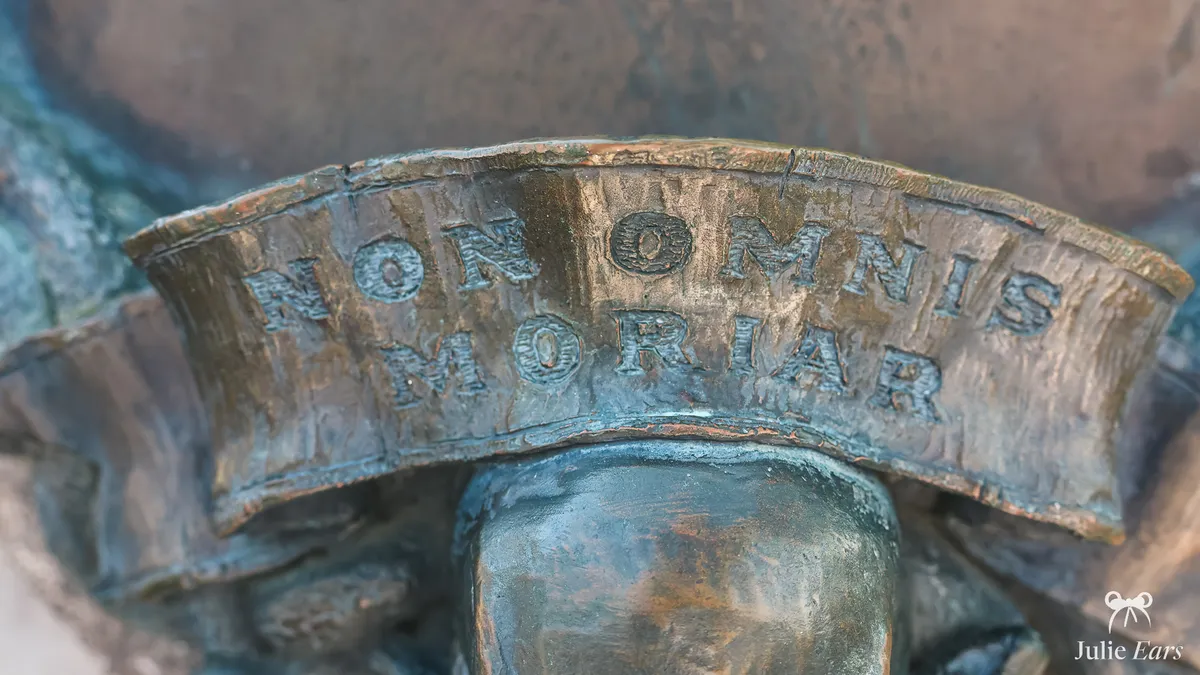
- At the entrance, a plaque framed by coiled snakes bears the house motto: "Non Omnis Moriar," Latin for "not all of me will die" (a line from Horace). Fitting for a family that won’t let go of this world, and also a warning from the Phantom.
- Every so often, Melanie shows up at one of the facade’s windows holding a candle and drifting from room to room, a lifelike touch that most visitors miss.
- The Ravenswood mansion can be seen from the mountain’s train AND from the Riverboat deck: the three locations were deliberately designed as one whole.
- Aboard Big Thunder Mountain, watch for the animated scenes: a goat tugging at a shirt on the clothesline, tethered donkeys braying as the trains go by, and smoking dynamite on the final lift hill. All nods to the mining town. The Thunderbird itself is hidden in the rock: to catch a glimpse, look down in the turn just before you enter the mine, right at the explosion that follows the earthquake.
- The clothes hanging out to dry as the train starts its second climb are Catfish Joe’s. He’s an old fisherman living with his dog on the far side of the mountain, and you’ll see him again, rod in hand, as the Molly Brown circles the lake: one character popping up on two attractions, which proves Thunder Mesa is a single continuous setting.
- The mountain’s animals have names chosen as a wink: the two donkeys are called Beth and Bjørn, and the billy goat is Yon, a tribute to Beth Clapperton and Bjørn Heerwagen, two leaders of the design team (you already came across their names above, in the 2018 refurbishment).
- The town’s businesses recall its mining past: Fort Comstock at the entrance, the Thunder Mesa Mercantile Building, and the Lucky Nugget Saloon (founded in 1858 by Miss Diamond Lill). The signs carry the mining theme further: the Lucky Nugget Saloon is named for a prospector’s lucky find, the Silver Spur Steakhouse points to silver, and the Eureka Mining Supplies store borrows the "Eureka" prospectors shouted when they found a nugget.
- Boot Hill, the hill overlooking Thunder Mesa, is home to both the mansion and the town cemetery: a classic Old West name for a graveyard.
- The Master Gracey character in the mansion pays tribute to Imagineer Yale Gracey, the master of ghost illusions.
- For years, from opening day in 1992 until the 2018 refurbishment, Disney deliberately kept guests guessing about who the Phantom really was.
Beyond Thunder Mesa, you’ll find wider winks that run throughout the park. To track down the well-known Hidden Mickeys (Mickey shapes slipped in all over the place), check out Hidden Mickeys. And for more secrets hidden around Disneyland Paris, browse the secrets of Disneyland Paris.
If you like this kind of behind-the-scenes story, other backstories in this series may interest you: the Pirates of the Caribbean backstory, the story behind the Tower of Terror, or the one behind Indiana Jones.
Frequently asked questions
01 Does Phantom Manor, the haunted house, have an age limit?
No, Phantom Manor has no minimum age or height requirement: everyone can ride. It’s a gentle, dark ride with a mysterious mood, but there’s nothing really scary and no big thrills. Little ones who are sensitive to the dark may find it a bit intimidating, so it’s your call.
02 What year did Big Thunder Mountain and Phantom Manor open at Disneyland Paris?
Both rides opened on the park’s opening day, April 12, 1992 (back then, the park was called Euro Disneyland). What makes Big Thunder Mountain special is that it’s the only one of the four Big Thunder Mountains in the world to open on its park’s very first day.
03 Who is the Phantom in Phantom Manor?
Since the renovation, the official version reveals that the Phantom is Henry Ravenswood, Melanie’s father. Back from the dead, he poisoned his daughter’s suitors one after another to keep her by his side. The mystery about who he was had been kept alive on purpose for years, from the 1992 opening until the renovation.
04 What’s the story of Big Thunder Mountain at Disneyland Paris?
Big Thunder Mountain is set on a mountain in the American West loaded with gold and silver and watched over by the Thunderbird, a spirit from Native American legend. In 1853, prospectors hit gold there. Once dynamite violates the rock, though, the Thunderbird wakes up and lets its anger loose. In 1860, an earthquake flattens the mine and the town. Since then, the trains have circled the mountain by themselves, with nobody at the controls. The out-of-control mine train you board is that curse playing out.
05 Do Big Thunder Mountain, Phantom Manor, and the Riverboat tell the same story?
Yes. Tony Baxter’s Imagineers deliberately tied all three attractions to one made-up town, Thunder Mesa. Gold dug from the mountain turns Henry Ravenswood into a wealthy man, who then builds both the town and his mansion. When the mountain is desecrated, the Thunderbird stirs, and its anger triggers the 1860 earthquake, which kills the Ravenswood family and seals the town’s fate. As for the Riverboat, it loops around the river so you can take in every one of these spots at once.
06 What are the secrets and hidden details of Thunder Mesa?
Some of the most striking ones: the Latin motto "Non Omnis Moriar" carved at the manor’s entrance ("I shall not wholly die," from Horace), Melanie appearing at a window on the facade holding a candle, the manor visible from both the train and the boat, and the animated scenes on Big Thunder Mountain (the goat, the donkeys, the smoking dynamite). For Hidden Mickeys and secrets across the whole park, see the dedicated articles.


