



What is the story of Indiana Jones and the Temple of Peril?
The story is set in the 1940s. Henry Jones Jr., better known to everyone as Indiana Jones, is as much an archaeology professor as he is an adventurer. He leads an expedition into a thick jungle to track down a lost city, The Lost City.
As the dig goes on, his team never finds the city it was hoping for, but it does find something else: the remains of a temple forgotten for more than a thousand years. The find is so large that the expedition settles in for good. The crew digs into the hill, sets up camp, and builds a small network of rails to carry away whatever it unearths.
That’s where it all begins. Every bit of scenery you walk through captures that exact moment: a busy excavation site, frozen as if the archaeologists had only just left. For the practical details (line, height requirement, thrills), see Indiana Jones and the Temple of Peril.
Which god does the temple honor, and what’s with the cobras?
The ruins the expedition dug up belong to a temple honoring Shiva, a major deity in Hindu mythology. A pair of giant stone cobras flanks the entrance staircase, one on the left and one on the right. In the tradition, this snake, called the Naga, goes hand in hand with Shiva, who is often pictured wearing it wrapped around his neck.
That’s exactly where the people who designed the ride hid an inside joke that fans can’t get enough of: on screen, Indy is terrified of snakes. Putting two enormous cobras in charge of the temple is the perfect little touch to link the setting with its hero. The most fearless adventurer around, face to face with his worst nightmare.
What does the excavation site scenery tell you?
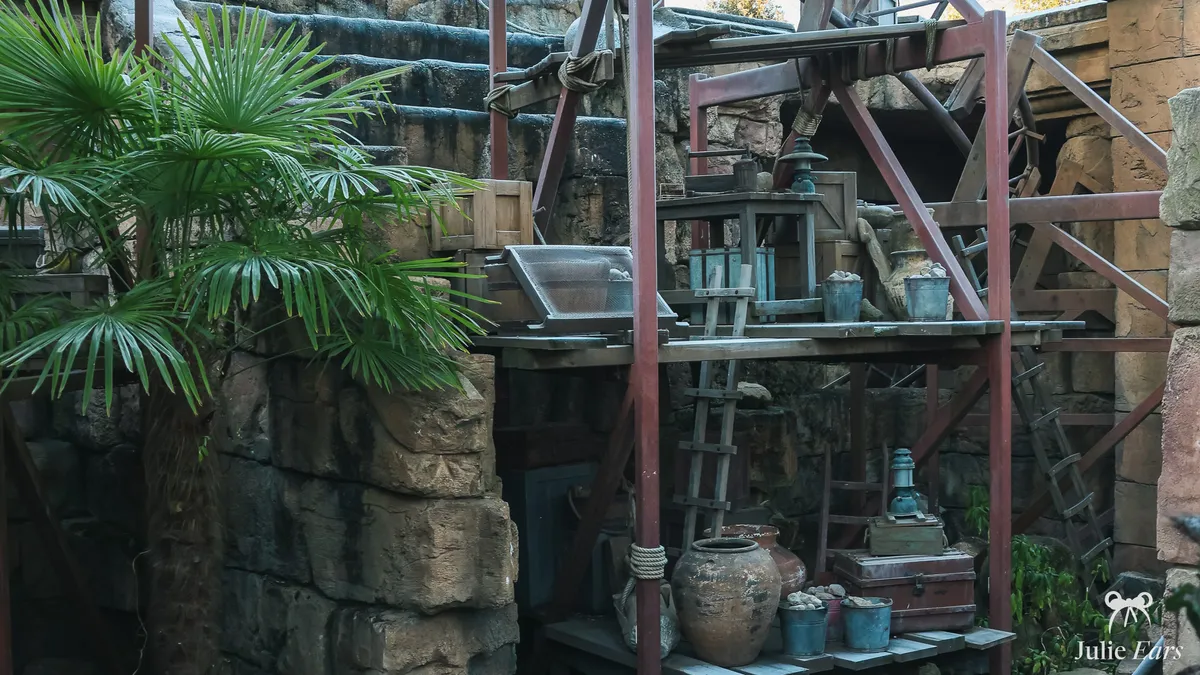
Here’s where the storytelling does its best work. The line isn’t a plain hallway to shuffle through: step by step, you’re walking around the expedition’s base camp. Every detail is there to convince you the team had to clear out in a rush, abandoning all their gear exactly as it was.
- The archaeologists’ camp: tents, cots, supplies, and even a small makeshift lab
- Notebooks and typewriters sitting out, as though someone was still writing up what got dug up that day
- A figure of Shiva, the temple’s god, standing outside one of the tents
- Ancient vases, a carved tiger head, and stacks of shipping crates
- The network of mine rails, laid to haul the ruins out of the hill
Why do you ride in a mine cart?
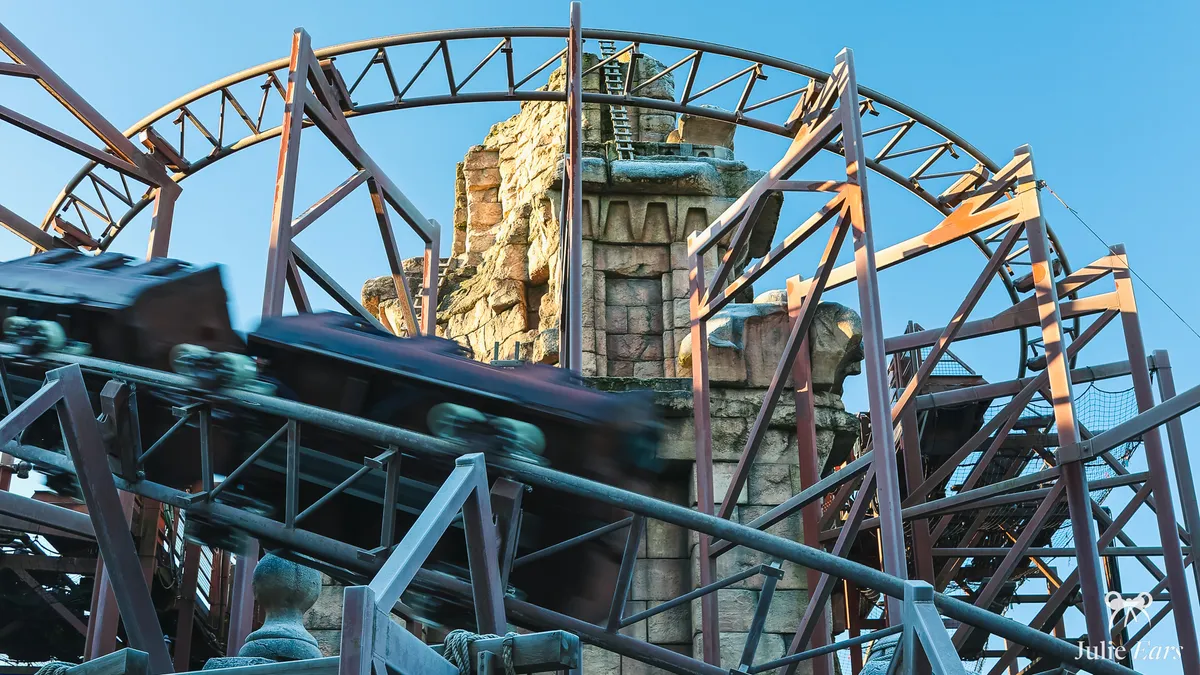
In the story, the work carts were used to haul the treasures out of the temple. The expedition left them on the tracks. You, the guest, become an adventurer in turn, hopping into these abandoned cars and racing through the ruins at high speed.
The mine cart ride isn’t a coincidence: it echoes Indiana Jones and the Temple of Doom, the 1984 movie in which the heroes speed along the rails of a mine. If that scene rings a bell, it’s exactly the mood Disney set out to recreate here.
For what it’s like once you’re on board (the thrills, the loop, how it really feels) and all the practical info (line, height requirement), everything is covered on the Indiana Jones and the Temple of Peril page.
Who are the characters in this story?
| Character | Role |
|---|---|
| Indiana Jones | The archaeology professor who stars in the movies. He heads up the dig and is the one who finds the temple. |
| Marcus Brody | Indy’s friend and colleague in the movies. His name shows up on a shipping crate as a little wink. |
| Shiva | The Hindu god the temple is dedicated to, represented by the Naga cobra. |
| The Lost City | The city the expedition was searching for in the jungle when the adventure began. |
| The Temple of Peril | The ancient Shiva temple the excavation brings to light, more than a thousand years old. The ride is named after it. |
When did it open, and whose idea was it?
Now for the behind-the-scenes part, the real story of the ride. It opened in Adventureland on July 30, 1993, a little over a year after the park itself, and was officially dedicated on November 9, 1993, with George Lucas in attendance. And it was no ordinary roller coaster: it was the first coaster in a Disney park to include an inversion, in other words a loop.
Before this, flipping riders over was something Disney simply wouldn’t do. The Temple of Peril tore up that rulebook.
The ride was designed by the Imagineers at Walt Disney Imagineering, the company’s in-house creative studio, under the lead of Tony Baxter, one of the big names behind the Paris park. The engineering side went to the Swiss manufacturer Intamin, with the company Giovanola handling the structure.
In Tony Baxter’s own simple words, the concept was a set of mine cars climbing and diving over the top of the temple, hauling off debris and returning the treasures to where they belong. In other words, the coaster is the excavation, told as a ride.
Why a roller coaster and not a whole land?
The original plan was far more ambitious. Disney dreamed of a full Indiana Jones land, an entire area devoted to the adventurer, with a much longer mine cart ride and indoor scenes inspired by the movies. But the park’s early years were a real financial struggle, and the plans had to be scaled back.
Out of that big project came a compact but carefully crafted coaster, set on a hill in Adventureland. The need was clear: to give guests a thrill ride while Space Mountain was still two or three years away. So the Temple of Peril filled that role, delivering the thrills until the rest arrived.
How has the ride changed over the years?
At one point, the coaster took a rather surprising turn. Hoping to win riders back, the park chose to send it backward. For just over four years, trains ran the exact same circuit in reverse, billed as "Indiana Jones and the Temple of Peril: Backwards!"
It wasn’t just a matter of flipping the direction. The car bodies had to be turned around on their chassis, two seats were added to each car, and above all, loads of scenery and lighting had to be moved so guests would never catch a glimpse of the technical backstage areas while facing the wrong way. Some sections of track were even reshaped for comfort.
Eventually, trains started running forward again, as they had on day one. Years after that, a big makeover rebuilt the whole structure using actual stone.
Opening day
The ride opens in Adventureland on July 30, 1993 and becomes the first roller coaster in a Disney park to feature a loop.
An early scare
Only weeks into its run, a problem with the brakes shut the coaster down for a while so everything could be inspected.
The backward version
From April 1, 2000, to November 27, 2004, the trains are turned around and sent off in reverse, with two extra seats per car.
Back to the classic direction
The ride returns to its original direction, the one it had on opening day.
The major refurbishment
Following a closure of several months, the coaster comes back with its structure redone in actual stone and its loop made a bit bigger.
Which hidden details and secrets can you spot?
The scenery is packed with references to the Indiana Jones movies. These details are what make a Disney ride so much fun: you can fall in love with the story just by knowing where to look.
The fedora and the whip
You’ll find Indy’s two signature props sitting on some scaffolding close to where you walk in.
Barnett College
Look for a shipping crate marked for Marcus Brody, care of Barnett College, the made-up school where Indy is a professor on screen.
Period vehicles
A customized Willys Jeep and a truck, military vehicles that bring to mind the feel of the hero’s adventures.
The Esso jerry cans
Fuel cans stamped Esso, a holdover from the ride’s original sponsor when it opened.
The Shiva statue
Outside one of the tents stands a figure of the god, and that’s on top of the two huge cobras watching over the staircase.
These details are only part of the scavenger hunt. The whole park is full of little nods: for the famous Hidden Mickeys as well as the other Disneyland Paris secrets, I’ve written dedicated articles that reveal every hiding spot.
The legend in a few steps
Into the jungle
It’s the 1940s. Indy organizes an expedition and pushes deep into the jungle, hunting for a lost city, The Lost City.
Finding the temple
They never find the city. What they dig up instead is a temple nobody has seen in over a thousand years, built for the god Shiva and watched over by a pair of stone cobras.
Setting up the dig
The expedition moves in: it pitches a camp, digs into the hill, and lays mine tracks to haul out the ruins.
Carts on the rails
Small work carts bring the treasures out of the temple, running along the network of tracks laid across the site.
The abandoned dig
The team leaves with everything still in place. You arrive, climb into a cart left on the tracks, and race down through the ruins yourself.
Did you like this tale? Plenty of other rides in the park hide a backstory of their own, and the Disneyland Paris history hub gathers every one of them. For more of these behind-the-scenes stories, check out the Thunder Mesa saga, the story of Pirates of the Caribbean, Tower of Terror, Ratatouille, or Avengers Campus.
For all the practical details on the ride (height requirement, line, thrills), head to the Indiana Jones and the Temple of Peril page.
Frequently asked questions
01 What’s the story of Indiana Jones and the Temple of Peril?
In the 1940s, archaeologist Indiana Jones sets off to find a lost city in the jungle. Instead, he stumbles on a temple forgotten for a thousand years and dedicated to the god Shiva. His crew digs into the hill and lays mine tracks to haul out the treasures, then abandons the site. You board those deserted mine carts and race down through the ruins.
02 What year did Indiana Jones and the Temple of Peril open?
The ride opened on July 30, 1993, in Adventureland. It was a first for Disney, becoming the first roller coaster in a Disney park to feature an inversion, in other words a loop.
03 Is it true the ride once ran backward?
Yes. From April 1, 2000, to November 27, 2004, it operated under the name "Indiana Jones and the Temple of Peril: Backwards!" The trains were turned around and sent out in reverse, with two extra seats per car. It then went back to running in its original direction.
04 Why cobras, and which god is the temple built for?
Shiva, a central deity in Hindu mythology, is the god this temple honors. A pair of cobra statues, depicting the serpent Naga, stand watch over the steps, since that snake is one of Shiva’s symbols. It also winks at Indy’s well-known dread of snakes in the movies.
05 Which secrets and little details are hidden along the line?
The setting is packed with movie references: Indy’s fedora and whip on a scaffold, a crate addressed to Marcus Brody at Barnett College (his fictional university), a Willys Jeep and a vintage truck, Esso jerry cans from the original sponsor, and a statue of Shiva in front of a tent.


