



Before getting into the detail, a word for first-time visitors: what follows is the story Disney imagined for the ride, its themed backstory, then the story of how it was designed and what went on behind the scenes. To place all this in the wider history of the park, see my section on the history of Disneyland Paris. For all the practical details (where to find it, how long it lasts, accessibility), head to the Pirates of the Caribbean page. Here, I’m telling the story.
What is the story of Pirates of the Caribbean at Disneyland Paris?
The story rests on one strong idea: in Paris, you experience it in reverse. Where the other Disney parks start with the caves and the pirates’ remains before going back in time, Disneyland Paris turned everything around. The ride starts with living chaos, the attack on a Spanish fort, and ends with its grim outcome, the curse.
The setting sets the tone straight away: the ride is housed in an Adventureland building inspired by an elegant New Orleans mansion, with a Spanish colonial-style facade (the Caribbean Plaza section).
You board a boat on a lagoon at night. It’s calm, almost sleepy. Then the story picks up speed: the boat is hauled up a lift ramp and at the top, surprise, you’ve slipped into the past. The battle has already begun.
In Paris, the direction of travel is the story. Each drop (there are two) marks a turning point in the tale. That’s what makes it the most narrative of all Disney’s Pirates rides and, I find, the darkest.
Rollercoaster fans know that the climb at the start of this kind of ride builds suspense. As you go up, you can’t see much, but you know you’ll soon be looking down on everything and about to experience something extraordinary. That’s why it mattered to put this ramp at the very start of the adventure.
The story, act by act
Act 1: the calm before the storm
You board at night on a lagoon. The boats glide past the tables of a waterside restaurant, pass a stranded wreck, then approach a hidden cove at the foot of an old fortress. Nothing has kicked off yet.
Act 2: travelling through time
The boat is hauled up the fort’s lift ramp. At the top, you’ve gone back in time: flames, and the shadows of pirates and soldiers fighting. You’ve slipped into the past.
Act 3: storming the fort
You pass through the flooded jail, where captive pirates try to coax a dog holding the keys in its mouth. Then a first drop sends you into the middle of a cannon battle: the pirate galleon, the Wicked Wench, and the soldiers of the Spanish fort fire at each other.
Act 4: sacking the town
The town has fallen. The pirate captain interrogates Carlos, the mayor, who is tied to a chair and dunked in a well ("Talk, you scoundrel! Where’s the treasure?"), while a pirate musician mocks him on the flute. Further on, a villager and a female pirate cross swords. Then the town goes up in flames, and a second drop carries you away just as the arsenal explodes.
Act 5: the curse
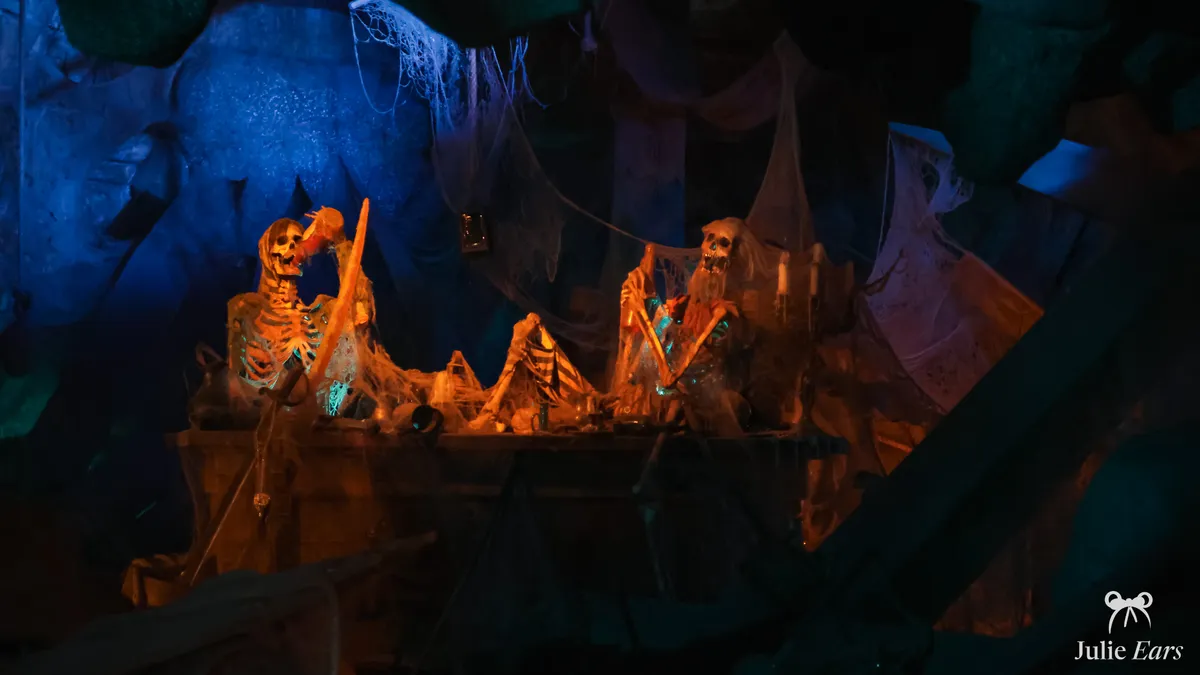
You emerge in the present, in the treasure grotto. The loot is still there, but its guardians are now nothing but skeletons. Greed got the better of them all. A talking skull delivers the final verdict.
What does "Dead men tell no tales" mean?
Right at the end of the ride, a talking skull speaks to you. It issues its warnings and repeats the line that sums it all up: "Dead men tell no tales", in other words the dead can’t tell anyone what happened.
That’s the moral of the story. The pirates looted, burned and killed for treasure, and it was the death of them. No one is left to enjoy the loot or even to tell what happened: only bones remain. In Paris, the skull also takes the chance to ask you to stay seated until the boats come to a complete stop.
Did the ride come before or after the films?
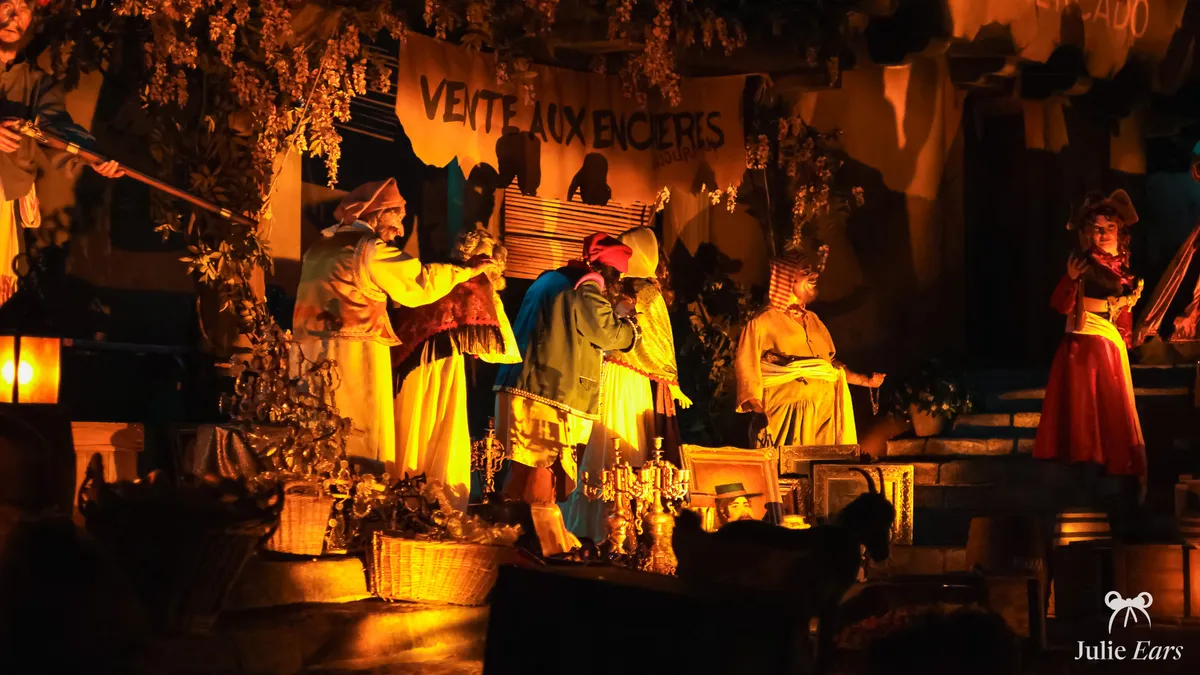
This is what surprises visitors most: the ride came before the films. The very first version, at Disneyland in California, opened in 1967. It’s the last attraction whose design Walt Disney personally oversaw: on his last visit to the studios in November 1966, shortly before his death, he was able to see the fully animated auction scene, even though the ride wouldn’t open until March 1967.
The first film, The Curse of the Black Pearl, only came out in 2003 and was inspired by the ride, not the other way round.
At Disneyland Paris, Pirates of the Caribbean therefore opened on 12 April 1992 without a single film character. It was only in 2017, during a major refurbishment, that Disney went the other way by slipping the saga into the original scenery. The ride inspired the films, which in turn fed into its renovation.
How was the ride dreamed up?
Walt Disney was fascinated by pirates throughout his career: as early as 1927, one of his Alice Comedies shorts was already set in a world of buccaneers. The idea of an attraction dates back to 1957.
Even before Disneyland in California was finished, Walt was thinking of expanding it with a district called New Orleans Square, which was to house a shopping area, a haunted house and a wax museum devoted to the history of piracy.
The project was put on hold in 1962: Walt Disney moved his teams onto the 1964 New York World’s Fair. This detour changed everything. There the Imagineers (the team that designs the parks, brought together as Walt Disney Imagineering) developed new ride systems, the boats on rails of it’s a small world, and pushed Audio-Animatronics technology forward with a talking figure of Abraham Lincoln.
Thanks to these advances, the Pirates project dropped the idea of a walk-through in favour of a boat cruise packed with special effects. The wax museum had become a living attraction.
An old fascination
As early as 1927, a Walt Disney short (the Alice Comedies series) already features a world of buccaneers.
The first idea
Walt Disney dreams up a New Orleans Square district, with a wax museum devoted to the history of piracy.
The New York Fair turning point
While preparing the 1964 World’s Fair, the Imagineers (the park design team) develop boats on rails and push Audio-Animatronics forward: the project becomes a boat ride.
Opening in California
The first version opens at Disneyland, California, in March 1967. It’s the last attraction whose design Walt Disney personally oversaw.
The reference version
A re-edited version of the ride later serves as the basis for the Paris storyline.
Opening at Disneyland Paris
Pirates of the Caribbean opens in Paris without a single film character, with the story reversed to make it more chronological.
The first film
The Curse of the Black Pearl hits cinemas. It was inspired by the ride, not the other way round.
The major refurbishment
Jack Sparrow and Hector Barbossa make their entrance as latest-generation Audio-Animatronics, and the soundtrack is completely remixed.
Why does the Paris version tell the story backwards?
It’s the big design choice. On the other Pirates rides (California, Florida, Tokyo), the journey starts with the caves and the pirates’ remains, then goes back in time to the party. In Paris, the Imagineers reversed the order of the scenes to make the story more chronological and linear: you start with the attack on the Spanish fort, followed by the sacking of the town, and finish with the curse.
The Paris storyline is in fact based on the 1973 version of the ride, re-edited to fit this new scenario.
A technical constraint reinforced this choice. In Paris, since it wasn’t possible to dig down as elsewhere, the ride was largely built above ground. Hence a taller facade, a double drop and that opening lift ramp which, instead of simply raising the boats, became the key moment when you slip into the past.
The building itself reflects this blend of influences: a Spanish colonial Caribbean mansion, just like the park as a whole, conceived as a bridge between the American imagination and a European setting.
How many animated figures are there and how do they work?
The Paris ride has over 100 Audio-Animatronics characters, the robotic figures that bring the scenes to life. How much they move depends on what each scene needs: from a simple repeated gesture to imitating an actor’s performance, like the duellists crossing swords in the residential quarter.
Making one of these figures takes several months. The work starts with models, then a metal and fibreglass skeleton threaded with wires and tubes, which is covered in a silicone skin and dressed.
The movements are driven by the soundtrack and combine pneumatic and hydraulic cylinders. Real-time electronic adjustment of the hydraulic pressure has made the gestures more natural and precise. Programming them, however, is still long and delicate work.
Who are the Imagineers behind the ride?
Behind the boats is a team of artists whose names crop up throughout the history of the Disney parks.
| Name | Role on the ride |
|---|---|
| Marc Davis | Design of the gags, scenes and characters, including the comic tone |
| Yale Gracey | Special effects and illusions, especially the illusion of the fire’s flames |
| Blaine Gibson | Sculpting the faces of the Audio-Animatronics figures |
| X Atencio | Script, dialogue and lyrics of the song Yo Ho (A Pirate’s Life For Me) |
| Tony Baxter | Design of the Disneyland Paris version and its story told in reverse |
The Imagineers behind Pirates of the Caribbean
Pirates of the Caribbean literally takes you into another world. When you get into the boat, everything is calm, almost asleep. Then you find yourself in another time. That’s why Pirates of the Caribbean is the best example of virtual reality: everything in it is virtually real.
Where does the song "Yo Ho (A Pirate’s Life For Me)" come from?
The ride’s theme tune, "Yo Ho (A Pirate’s Life For Me)", dates from the 1960s. It’s sung by three pirate musicians sitting by the canal. Walt Disney wanted a traditional sea shanty and asked the Imagineer designing the ride to write it himself, with help from George Bruns, Disney’s in-house music director (101 Dalmatians, The Jungle Book).
Writing for a ride comes with an unusual constraint: the song can have no beginning and no end, and each verse has to stand on its own, since there’s no way of knowing at what point each visitor hears it. The Paris soundtrack is based on the 1973 one, with dialogue specially recorded to include French and Spanish. It was completely remixed in 2017, with a few themes from the films slipped into the original melodies.
What changed in the 2017 refurbishment?
After several months of work, the ride reopened in July 2017 with additions designed to link the original story to the film saga without distorting it. Two latest-generation Audio-Animatronics characters made their entrance: Jack Sparrow and Hector Barbossa. To bring them to life, the teams studied the film actors’ body language and expressions so they could reproduce them faithfully.
The final auction scene was reworked: Jack Sparrow takes advantage of the chaos to grab the coveted treasure map, hides in a barrel, then celebrates his triumph with a bottle of rum.
An arsenal explosion now sends visitors into the treasure grotto, where you find Jack sitting on his mountain of coins. Finally, the soundtrack was completely remixed with a new sound system.
What’s the story behind Captain Jack’s restaurant?
At the start of the ride, the boats glide past the tables of a restaurant set on the water, the Blue Lagoon Restaurant. The ride’s building also houses Captain Jack’s - Restaurant des Pirates, which serves Caribbean food and has its own backstory.
The corridor leading to it displays a large map of the Caribbean and framed vignettes signed by Marc Davis, including the tribute slipped in at the bottom of the map. According to the story, Jack Sparrow won the place in a bet against Angelica Teach, Blackbeard’s daughter. The proof is hidden in the setting: on a sign, the name "Angelica Teach" is crossed out and replaced with "Captain Jack Sparrow".
Whether it’s open and how to eat there are practical details, so rather than fix them here, I’ll point you to its dedicated page. Captain Jack’s restaurant
What secrets and hidden details can you look out for?
- Captain Jack Sparrow slumped on his treasure throne at the back of the grotto: he blends into the loot, so you have to look for him.
- At Captain Jack’s, the map of the Caribbean shows Marc Davis with his famous cigarette holder, at the bottom of the map.
- The restaurant sign where Angelica Teach’s name is crossed out and replaced with Jack Sparrow’s.
- A chicken lost in the middle of the looting scenes and the dog holding the cell keys in its mouth.
- The direction of the story itself: keep in mind that you’re travelling from the past to the present, which is what makes the final shift so powerful.
For Hidden Mickeys and other nods scattered throughout the park, I’ll point you to the secrets of Disneyland Paris. If you enjoy this way of telling a ride as a story, the park is full of them: carry on with the Thunder Mesa saga, which includes Big Thunder Mountain, with Phantom Manor, the story of Space Mountain, or widen your view with Disney parks around the world. And for everything practical about Pirates of the Caribbean, the Pirates of the Caribbean page is your go-to reference.
Frequently asked questions
01 What year did Pirates of the Caribbean open at Disneyland Paris?
The ride opened in 1992, on the park’s opening day, in Adventureland. It’s one of the very first rides at Disneyland Paris and was there from day one, long before the films came out.
02 Why does the Paris ride tell its story backwards?
The Imagineers reversed the order of the scenes compared with the other parks to make the story more chronological: you start with the attack on the Spanish fort, then the looting, and end with the curse. The two waterfalls mark the turning points. This makes the Paris version the most story-driven Pirates at Disney.
03 Is the ride based on the films?
No, it’s the other way round. The first version opened in 1967, while the first film came out in 2003 and was inspired by the ride. In Paris, where it opened in 1992, characters from the films such as Jack Sparrow and Barbossa were only added in 2017.
04 What changed in the 2017 makeover?
The ride reopened in July 2017 with two latest-generation Audio-Animatronics figures, Jack Sparrow and Hector Barbossa, a reworked final auction scene (Jack grabs the treasure map), an arsenal explosion that sends the boats into the grotto and a fully remixed soundtrack featuring themes from the films.
05 How many animated figures does the ride have?
The Paris ride has over 100 Audio-Animatronics characters. Their movements range from a simple repeated gesture to imitating an actor’s performance, like the sword-fighting duellists. As for the treasure in the grotto, it’s made up of nearly 50,000 coins glued on by hand.


