



This page tells the backstory of the ride (the story Disney wrote for you, the tale that plays out in the queue and on the ride itself), then what goes on behind the scenes: how it was designed, who by and what it hides. For practical information (queue, Single Rider, minimum height, accessibility), everything is on the ride page: Ratatouille : L’Aventure Totalement Toquée de Rémy.
Good news for first-time visitors: you can love this story without ever having done the ride, and even without knowing the film by heart. I’ll take you through it all in order.
What is the story of the Ratatouille ride?
The starting idea fits in one sentence: Remy, the cooking rat, wants to make you a good meal. The trouble is that a rat is tiny and restaurants don’t like rats. So the whole ride plays with scale. You’re shrunk to the size of a rat so you can follow Remy into his world, and the restaurant kitchen turns into a giant playground full of dangers.
From there, the story becomes a comic chase. Remy chooses to cook you a ratatouille, it all goes wrong, and you flee through the stoves, the dining room and the walls of the restaurant, with Chef Skinner trying to catch you. It’s the Pixar film carrying on, told from a rat’s point of view.
La Place de Rémy: the setting that frames the story
Before you even board the vehicle, the story starts outside. The ride is surrounded by a little Parisian square called La Place de Rémy, in Disney Adventure World. This isn’t the real Paris. It’s the exaggerated, fanciful version of the city shown in the film, with its warm-toned facades and its bistro with a red veranda.
One detail is very cleverly done: the first floors of the buildings are deliberately smaller than the ground floors. This set trick makes the buildings look taller than they are and instantly gives that animated-film feel. It’s a first clue that here, everything will be about size and scale.
At the far end of the square, up on the rooftops, the giant sign of Gusteau’s restaurant watches over the neighbourhood. That’s where your adventure begins.
Who are Remy and Gusteau?
If you don’t know the film, here’s what you need to understand the ride. The story is set in the world of Ratatouille, the Pixar film released in 2007.
Remy
The hero: a rat with a passion for cooking, who dreams of becoming a chef despite being a rat. On the ride, he’s the one who welcomes you and wants to cook you a dish.
Auguste Gusteau
The great Parisian chef and Remy’s idol. His restaurant gives the place its name, Gusteau’s. His motto is still famous: anyone can cook. In the queue, his spirit greets you and shrinks you down.
Chef Skinner
The sous-chef who wants to get rid of the rats. He’s the one who hunts you down in the kitchen and tries to grab you through the air vents.
Linguini
The clumsy young kitchen hand and Remy’s ally. On the ride, he’s the one who helps you escape towards an air vent.
Emile
Remy’s greedy brother. You find him with the other rats in the cold store, feasting on the giant food supplies kept there.
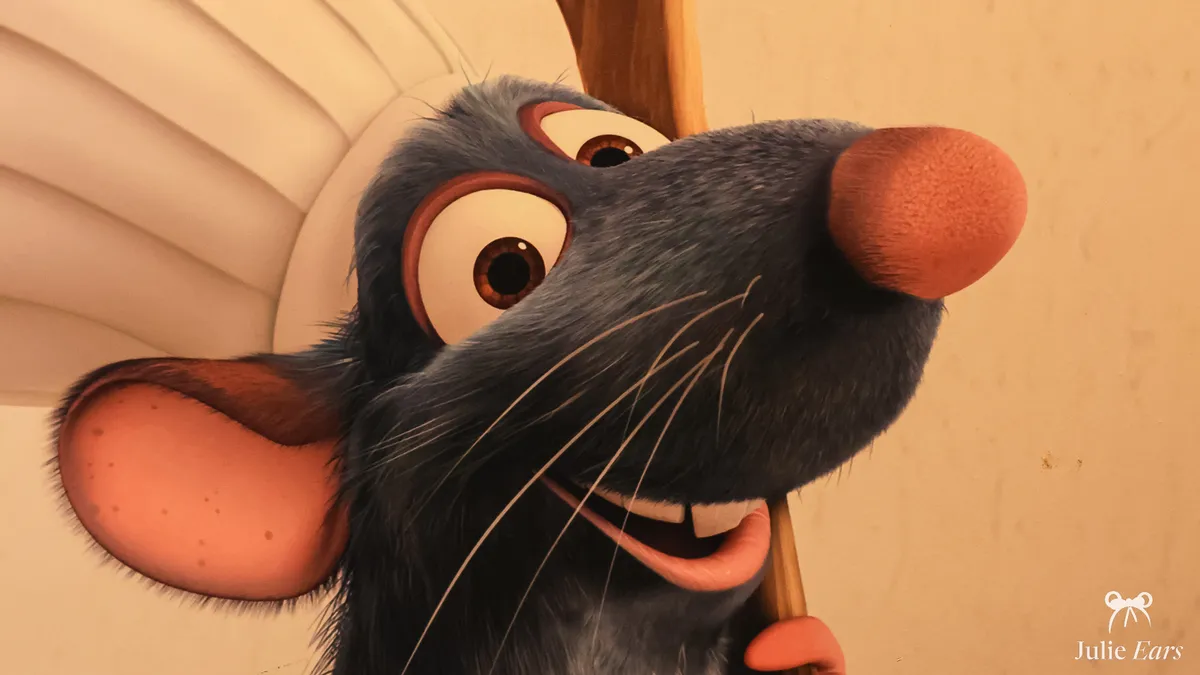
Shrinking down: becoming the size of a rat
The queue is part of the story. You walk through an artist’s studio, a loft, which gradually leads out onto the rooftops of Paris at night, beneath the glowing Gusteau’s sign.
That’s where the key moment happens: Chef Gusteau’s spirit welcomes you, in French and in English, and tells you that Remy is preparing something special for you. Then you’re shrunk to the size of a rat.
This shrinking is what drives the whole adventure. From that moment on, you no longer see the kitchen as a human would, but as Remy would: huge, overwhelming and full of obstacles at paw height. It’s this change of viewpoint that makes the story so playful.
The chase through the kitchens and walls
You board a rat-shaped vehicle on the restaurant roof. Remy and Gusteau decide what to cook for you and pick their famous ratatouille. Then everything changes: you fall through a skylight in the roof and land in the restaurant kitchen.
And so the escape begins. Remy leads you away from the cooks, past the scorching stoves and splashes of water. You burst into the dining room among panicking diners, then dash through the ducts and walls of the restaurant. Chef Skinner doesn’t give up: he even tries to grab you through the air vents, while Linguini helps you get away.
The ride plays a lot on the senses: the heat under the oven, the water, crossing the dining room on a trolley with giant wheels and a trip through a cold room where you can feel the chill. That’s where you find Emile and the other rats, feasting on the stored supplies (fish, cheeses and vegetables that have become gigantic at your scale).
The rooftops of Paris
You arrive beneath the Gusteau’s sign. The chef’s spirit welcomes you.
Shrinking down
You become the size of a rat. Remy is going to treat you.
The fall into the kitchen
You fall through a skylight and land in the restaurant kitchen.
The escape through the walls
A chase through stoves, dining room, cold room and ducts, with Skinner on your heels.
The finale at Remy’s
In his kitchen, Remy and Gusteau wave you goodbye while the rat colony tucks in. A champagne cork then sends your vehicle off towards the exit.
The finale brings you back to Remy’s kitchen, where the ratatouille is ready. Remy and Gusteau say goodbye while the whole rat colony enjoys the dish. It’s a warm, foodie ending, true to the moral of the film. To round off the adventure, a popping champagne cork sends your vehicle shooting out of the kitchen towards the exit.
At Disneyland Paris, the ride actually leads into a real restaurant, Bistrot Chez Rémy: the place Remy opens at the end of the film.
When and how was the ride created?
Now for the behind-the-scenes part. The ride opened to the public on 10 July 2014, but its story starts well before that. Construction began as early as 2012, under a rather telling internal working title: one that translates as Ratatouille: Kitchen Disaster.
The project was made official in March 2013, then inaugurated on 21 June 2014 by Bob Iger, then CEO of The Walt Disney Company, before opening to the general public a few days later.
At the time, it was Disneyland Paris’s biggest investment in a long while. It had a double aim: give the second park, which was then rather short on big new rides, a major attraction, and root it in a French world, which made perfect sense for a park near Paris. A Pixar film set in the French capital was the perfect choice.
Who came up with the ride?
The ride was designed by the Imagineers of Walt Disney Imagineering, the creative team that designs Disney attractions, under the creative direction of Tom Fitzgerald, one of the big names at the company. Their starting point: the scene in the film where Remy is chased through Gusteau’s kitchen. The whole ride grows out of this idea of a chase seen at rat height.
Their other source of inspiration is more surprising: an old classic of the American parks, Mr. Toad’s Wild Ride, the madcap ride where the vehicle careers off in every direction. The Imagineers wanted to create a modern version of it, boosted by new technology.
In the first models, they mostly pictured real built sets. In the end, they went for a mix of giant physical sets and video projections, which they felt worked better to make you feel tiny.
Trackless vehicles, the real feat
The big technical innovation is the vehicle: a rat-shaped car that moves without any track on the ground. Where most rides run on a fixed track, here the vehicles glide, turn, reverse and split into groups, as if steered by an invisible hand.
That’s what makes the chase feel so alive: you really feel as though you’re fleeing at random around the kitchen, never on rails.
Disney had never used this technology at Disneyland Paris before. To perfect it, the vehicles were tested in secret for months in a warehouse in the US before being shipped to France.
Only a handful of Disney rides around the world use the same trackless system, which makes this one all the more special. I won’t go into the mechanics here (they’re on the ride page), but this system is what makes the ride so smooth.
A setting built in two stages and refurbished since
A little construction secret: part of La Place de Rémy existed before the ride. Its Parisian-style facades started going up as early as 2010, at the same time as the neighbouring Toy Story Playland area. So Disney had set the scene well before opening the ride, which explains how well the area hangs together.
The ride has also changed over time. For ten years, you wore 3D glasses to see the projections in relief. During a major refurbishment that began in October 2025, Disney replaced every projector, dropped 3D in favour of sharper 2D images and added new giant sets designed by the Imagineers. The queue even gained a new artist’s studio scene, with its canvases, paint splashes and fruit bowl.
The ride reopened in spring 2026, once the works were finished. The story itself hasn’t changed: it’s still the same tale, just better told.
The first facades
Part of La Place de Rémy is built at the same time as the neighbouring Toy Story Playland.
Construction begins
Building starts under a working title that translates as Ratatouille: Kitchen Disaster.
Inauguration and opening
Inaugurated on 21 June by Bob Iger, the ride opens to the public a few days later.
Major refurbishment
New projectors, no more 3D glasses in favour of 2D, richer sets and a new scene in the queue. Reopened in spring 2026.
Hidden details to look out for
- Hidden rats are dotted around La Place de Rémy. At night, some of them sleep peacefully inside the street lamps: they’re Remy’s friends.
- The square is packed with nods to the film: Linguini’s bike, the Vespa stolen by Chef Skinner and Colette’s motorbike are all part of the scenery.
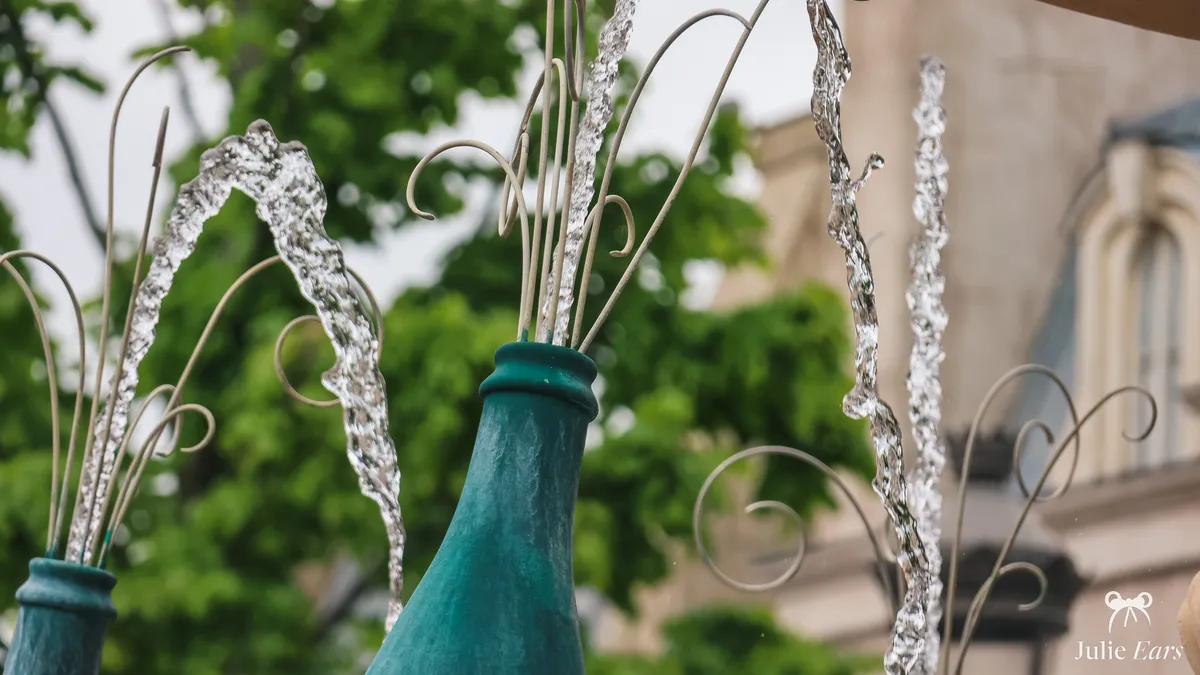
- The fountains also hide rats and champagne bottles, and on the manhole covers you can spot Remy sailing on Gusteau’s cookbook.
- At Bistrot Chez Rémy, you’ll find the character’s life story: Gusteau’s book Anyone Can Cook! and the awards Remy has won in cooking competitions.
- Also at Bistrot Chez Rémy, the furniture is made of oversized kitchen objects: chairs made from champagne corks, tables made from jar lids and giant cutlery as decoration.
- The outside of the ride is the facade of Gusteau’s restaurant, topped by its giant sign, visible on the rooftops.
If you love little secrets: I’ve gathered the Hidden Mickeys and nods scattered around the parks in my Hidden Mickeys guide, and the wider Disneyland Paris anecdotes in my article on the secrets of Disneyland Paris. They’ll give you plenty of reasons to look at the rest of the park differently.
To plan your visit in practical terms (queue, Single Rider, minimum height, accessibility), it’s all on the ride page: Ratatouille : L’Aventure Totalement Toquée de Rémy.
Fancy more stories like this one? This one is part of a series of behind-the-scenes stories in my section on the history of Disneyland Paris. In the same vein, read the Thunder Mesa saga, the story of Pirates of the Caribbean, the story of the Tower of Terror, the tale of Avengers Campus and the legend of Indiana Jones and the Temple of Peril.
Frequently asked questions
01 What year did the Ratatouille ride open at Disneyland Paris?
The ride opened to the public on 10 July 2014. It had been inaugurated a few days earlier, on 21 June 2014, by Bob Iger, then CEO of The Walt Disney Company. Construction had started back in 2012 under an internal working name, Ratatouille: Désastre en Cuisine.
02 What is the story of the Ratatouille ride?
Remy, the rat chef, wants to cook you a ratatouille. To follow him, you’re shrunk to the size of a rat, then you flee through the kitchens and walls of Gusteau’s restaurant, chased by Chef Skinner. At the end, Remy and Gusteau wave you off while the rat colony tucks in. It’s the Pixar film carried on, seen through a rat’s eyes.
03 What are the secrets and hidden details of the Ratatouille ride?
La Place de Rémy is full of nods: rats sleeping in the street lamps at night, Linguini’s bike, Skinner’s Vespa and Colette’s motorbike in the scenery, rats and champagne bottles in the fountains and Remy sailing on Gusteau’s cookbook on the manhole covers. At Bistrot Chez Rémy, the furniture is made of giant kitchen objects.
04 Has the Ratatouille ride changed since it opened?
Yes. For ten years, you wore 3D glasses to watch the projections. During a major refurbishment launched in October 2025, Disney replaced all the projectors, dropped 3D in favour of sharper 2D images and added a new artist’s workshop scene in the queue and new giant sets. The story itself hasn’t changed.
05 How does the Ratatouille ride work, and is it in 3D?
You board a rat-shaped vehicle that moves without tracks on the ground, which lets it turn, reverse and glide to mimic a real chase through Gusteau’s kitchens. Since the refurbishment launched in October 2025, the ride has dropped 3D glasses in favour of sharper 2D images, so you no longer need glasses.


