



Accessibility at Disneyland Paris
Disneyland Paris welcomes visitors with visible or invisible disabilities, visitors with reduced mobility, people with an ALD (a long-term condition recognised by the French health system) and pregnant visitors. The main arrangements are access cards, accessible rides and hotels, wheelchair hire, a welcome for guide dogs, support for food allergies and a 25% discount on tickets.
Accessibility matters a lot at the resort. It even has its own value among Cast Members (the park staff): the Inclusion key, which every new employee learns about when they join.
Two official resources help you plan your visit: an accessibility page on the Disneyland Paris website and an Accessibility Guide in PDF format, which you can download or pick up in paper form at the ticket windows. I recommend reading them before you go: they list, ride by ride, the restrictions you need to know about.
In this guide, I give you the overview. For each arrangement, you’ll find the essentials and a link to the detailed article.
The official Disneyland Paris Accessibility Guide (PDF)
The reference document published by Disney: access cards, accessible hotels, access to rides and services on site. The link opens the guide on the Disney website, so you always get the latest edition.
The access cards
To suit each situation, Disneyland Paris offers access cards and a wristband. They are not aimed at the same people and do not give the same benefits.
Priority Card
For visitors with a recognised disability, on official proof. It gives priority (but not always immediate) access through the dedicated entrance to rides, meet and greets and shows, access to the reserved areas for parades and outdoor shows and priority ticket desks. Full details in my guide to the Priority Card.
Easy Access Card (ALD)
For visitors with an ALD (a long-term condition recognised by the French health system), on a recent medical certificate. It does not skip the queue: you get a return time based on the queue time, you wait elsewhere and come back at the time given, with only one booking at a time. It mainly covers rides. Full details in my guide to the Easy Access Card.
Pregnancy wristband (Thumper wristband)
For pregnant visitors only, on proof of pregnancy. It gives the same priority access as the card on a selection of rides and replaces the old card for these visitors. Show it at the entrance to the ride.
How does ride access work?
Since the MagicALL programme was introduced, Disneyland Paris no longer thinks only in terms of the type of disability, but also in terms of your level of independence. When you arrive, you fill in an independence questionnaire with a Cast Member, then your photo is taken to print your card. According to the official wording, this questionnaire sets your level of independence so that staff and equipment can be adapted to evacuate you safely.
This level of independence is shown by a colour dot on your Priority Card. Access to each ride then depends on matching your level of independence with the ride’s own conditions: boarding, getting off and above all evacuation. You check these conditions on the Accessibility Maps (QR code on the card, paper maps or PDF) and choose the rides you can do.
In practice, visitors who cannot transfer from their wheelchair (unable to leave it to sit in the ride vehicle) can only go on rides equipped to take them.
On many rides, an adult companion able to help with an evacuation must be present. Plan for this: without a suitable companion, access can be refused for safety reasons.
| Dot | What it means |
|---|---|
| Green | Fully independent: you can board, get off and be evacuated on your own or with your companions. |
| Purple | Independent but with reduced mobility: for example a wheelchair user who can transfer to the ride seat on their own. |
| Orange | Partly independent: supervision is needed. |
| Blue | Unable to move around without assistance. |
| Grey | Non-independent visitor: a specific evacuation by the fire brigade may be needed. |
The colour dots on the Priority Card (your level of independence)
Priority or easy access: two different systems
| Priority Card | Easy Access Card (ALD) | |
|---|---|---|
| Who it’s for | Recognised disability (official proof) | Long-term condition (recent medical certificate) |
| How it works | Priority access through the dedicated entrance, no booking | Return time based on the queue time, one booking at a time |
| Does it skip the queue | Priority access (not always immediate) | No: you wait elsewhere, then come back |
| What it covers | Rides, meet and greets, shows, reserved areas, ticket desks | Rides only |
| Valid for | Your whole stay (or the length of the pass for Disneyland Pass holders) | The day |
| Companions | Up to 4 on rides, at meet and greets and indoor shows. 2 at outdoor shows or parades | Up to 4 on rides |
The discounted price for disabled visitors
Disabled visitors get a 25% discount on park tickets (1, 2 or 3 days), on the Disneyland Pass and on Disneyland Pass Night tickets. The discount applies to the disabled visitor and one companion, on showing valid official proof.
Hotel packages (hotel only or hotel and tickets) are not eligible for this discount. For the accepted documents and the steps to follow, see my guide to the disability discount ticket and my ticket guide.
Affiliate link · official Disney prices
Accessibility of rides and shows
Most rides are accessible to disabled visitors, but not all in the same way. Some can be boarded directly in a wheelchair, thanks to adapted vehicles that take you on board without leaving your seat. Others require you to transfer to the ride seat.
Finally, a few are not accessible. I don’t give a list here, because it depends on your situation and changes over time: you’ll find the details ride by ride in my ride guides and, for wheelchairs, in my guide to hiring a wheelchair.
Instructions are displayed at each dedicated entrance, and a QR code gives access to the Accessibility Maps. These maps bring together the useful symbols: evacuation conditions, the need to transfer from wheelchair to seat, lighting effects, flashes or strobe lights, photosensitivity.
Good to know: it’s your companions who help with the transfer, not the Cast Members, who assist you with boarding and can slow things down if you ask.
For indoor shows, there are dedicated spaces for disabled visitors and their companions, in limited numbers. Other services are available: audio description through the AudioSpot app, vibrating vests in some theatres and sign-song performances (the show’s songs performed in sign language) or French Sign Language (LSF) in some selected theatres. For parades and outdoor shows, night-time shows included, reserved areas offer a less crowded space and a good view.
They are open to Priority Card holders, usually with two companions at most. Ask a Cast Member on the spot.
To plan ahead, browse my ride guides and show guides.
Three more specific needs deserve a mention. Guide dogs and assistance dogs are allowed on the vast majority of rides and in most areas of the park. For the rare exceptions, a Cast Member will guide you on site. An induction loop is fitted on some rides and at some information points, for visitors with hearing aids. Lastly, if you are sensitive to flashes or strobe lighting effects, these effects are flagged at the entrance to the rides concerned.
To check these points ride by ride, the Disneyland Paris app offers dedicated accessibility filters (wheelchair boarding, transfer required, photosensitivity, assistance dog…). It’s the most reliable and up-to-date source, as it reflects the real situation at the time.
Accessibility for your situation
To help you find your way faster, here are the main arrangements grouped by situation. Each one links to the details.
- Physical disability and wheelchairs Adapted vehicles on some rides, transfer required on others, wheelchair hire on site, car park area closer to the entrance, accessible shuttle buses. Details in my guide to hiring a wheelchair and my ride guides.
- Visual impairment Audio description through the AudioSpot app, Virtuoz tactile maps, guide dogs welcome in the parks, hotels, shops and restaurants.
- Hearing impairment Induction loops, sign-song or LSF, vibrating vests, a dedicated kit at the hotel: see the practical services and the arrangements worth knowing below.
- Autism, intellectual or cognitive disability A dedicated welcome booklet, sensory cues marked on the Accessibility Maps, quieter areas to take a break. Overview below and details in my guide to visiting with an autistic person.
- Invisible disability and ALD Easy Access Card on a medical certificate confirming a recognised long-term condition. Exact conditions (and cases that are not eligible) in my guide to the Easy Access Card.
- Allergies and special diets Adapted dishes in most restaurants, to mention to the restaurant manager when you arrive. Details in the dedicated section below.
Visiting with an autistic or hypersensitive person
Noise, flashes, darkness and queuing can quickly become hard for an autistic or hypersensitive person. Disneyland Paris provides a welcome booklet dedicated to autism spectrum disorders (the Livret Bleu, or blue booklet), designed with specialists. It gives a sensory rating for each ride (noise level, light, surprise effects, length) that helps you choose what will suit and avoid what may cause overload.
On site, you can find quieter areas to take a break away from the crowds and ask Cast Members for advice: sensitivity varies from one person to another, and they know the content of each ride well. The Priority Card is also open to these visitors, for whom long queues are exhausting.
I explain how to organise an adapted day (preparation, quiet spots, pacing) in my guide to visiting with an autistic person.
Practical services on site
- Adult changing room A changing room for disabled adults or children over 3 is available at the First Aid centre in Disneyland Park (on Main Street U.S.A.) and at Cafe Luminosity in Disney Adventure World. It welcomes the person and their companions in private, with a hoist, an adjustable bed or seat, toilets and a shower.
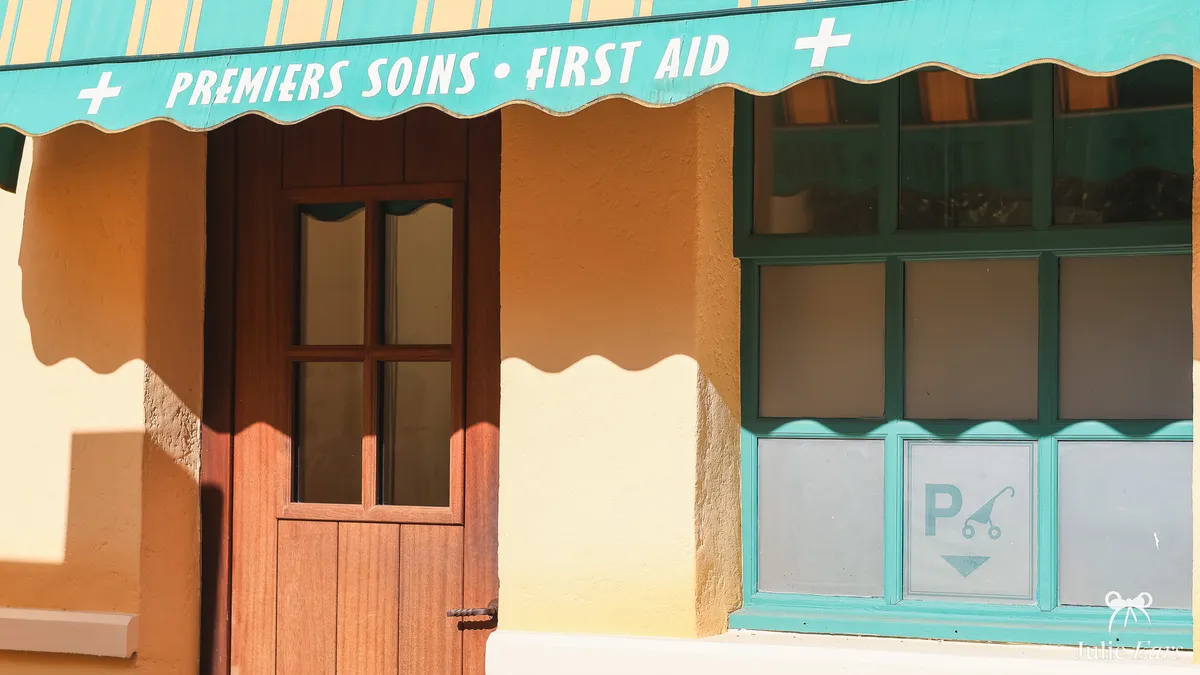
- First Aid and medication There’s a First Aid centre in each park, with qualified staff. You can have heat-sensitive medication (insulin, for example) kept cold there. Remember to bring your prescription if you need treatment or have to take medication.
- Hearing loops Some theatres are fitted with hearing loops for hearing aid users. Ask at the entrance to the theatre concerned.
- Kit for deaf and hard of hearing visitors An alert kit is available on request, when you book or at reception in your Disney Hotel (specific equipment, subject to availability). The toilets also have flashing lights in case of evacuation.
- Disneyland Paris app The free Disneyland Paris app shows where services are (including accessible toilets) and displays opening times and queue times. For access conditions ride by ride, rely mainly on the Accessibility Maps (QR code, paper or PDF).
Accessible Disney hotels
All Disney hotels offer accessible rooms for disabled visitors. They are usually more spacious, with a shower rather than a bath, more space around the bed and adapted toilets. Kits for deaf and hard of hearing visitors and a welcome kit for guide dogs are provided. At the pools, there is equipment to help you into the water and accessible changing cubicles.
These rooms are limited in number and subject to availability: I recommend booking as early as possible, by phone with the booking centre on +33 9 69 32 60 61 (not a premium-rate number). Mention your needs when you book or at the hotel reception.
Affiliate link · official Disney prices
Getting there and around: transport, wheelchairs, parking
If you arrive by train, Marne-la-Vallée/Chessy station (RER A Paris suburban train, TGV high-speed train and OUIGO) is accessible and only a few minutes’ walk from the park entrances.
For a stress-free arrival in a wheelchair or with reduced mobility, remember to book assistance in advance with the SNCF service (up to several weeks ahead and no later than 24 hours before departure): without a booking, it is not guaranteed. Below you’ll find the essentials for getting around on site.
- Wheelchair hire Standard wheelchairs can be hired in the parks, for use inside the park. Electric wheelchairs and mobility scooters go through an external partner. Details, prices and pick-up points in my guide to hiring a wheelchair.
- Your own equipment Personal manual and electric wheelchairs can get around the parks and hotels, step-free. Good to know: mobility scooters are not allowed on the shuttle buses, and there are no charging points for scooters in the parks or hotels. If you have any doubt about your equipment, check with Disneyland Paris before you come.
- Parking Everyone pays for parking, with no specific free parking. There is, however, a parking area closer to the entrance, open to holders of a disabled parking permit. Access and prices in my guide to the car park.
- Disney shuttle buses The free shuttle buses link the parks and the Disney hotels. They are wheelchair accessible, with reserved spaces. Mobility scooters are not allowed on them. Adapted minibuses can be requested on site for visitors who cannot transfer from their wheelchair.
- Guide and assistance dogs They are welcome in the parks, hotels, shops and restaurants. The dog must stay on a lead and under control, with its documents up to date. Some rides don’t allow it on board: a dedicated waiting area is then provided.
Allergies and special diets
Accessibility also means what’s on your plate. Most table-service and buffet restaurants offer adapted dishes covering the main allergens, prepared to avoid cross-contamination. It’s simple: mention your allergy to the restaurant manager as soon as you arrive and ask for the list of ingredients if needed.
For more specific diets (strict gluten-free, kosher, halal), let Disneyland Paris know in advance to make sure it’s available. I explain the steps in my article on allergies and special diets.
5 useful services worth knowing
Vibrating vests
Offered free of charge for a selection of musical shows (for example TOGETHER: a Pixar Musical Adventure), they turn sound into vibrations for deaf and hard of hearing visitors. Pick them up at City Hall or Studio Services. They are not recommended for people with a pacemaker or for pregnant visitors. Ask a Cast Member about availability on the day.
AudioSpot audio description
The AudioSpot app offers audio description for visually impaired visitors on some rides, in French and English. The list is growing gradually: check which rides are covered at the time of your visit.
Wheelchair carriages on the Disneyland Railroad
The park train now has adapted carriages with lifts: wheelchair users board without transferring, without leaving their wheelchair.
Guide dog area at Pirates of the Caribbean
A dedicated, supervised area looks after the guide or assistance dog during the ride when it cannot go on board. Extending this to other rides is being considered.
Tactile maps
Virtuoz Mini tablets offer tactile maps for visually impaired visitors. Virtuoz Maxi maps (raised relief and audio information) are available at City Hall and at Disney Hotel New York - The Art of Marvel.
Your checklist before you go
- Gather your documents Get the original paper documents ready (disability card, ALD medical certificate less than 3 months old, depending on your case) and photo ID. A photo taken on your phone is not enough.
- Apply for the card online Start your application about a month before your visit (questionnaire and photo), so you can collect the card quickly on the day.
- Book an accessible room early Accessible rooms for visitors with reduced mobility are few: book as early as possible by phone and mention your needs.
- Download the guide and the maps Get the official Accessibility Guide, the Accessibility Maps and, for an autistic person, the dedicated welcome booklet.
- Plan for a companion and breaks On many rides, an independent adult companion is required. Spot quieter areas in advance to catch your breath.
- Remember your medication You can have your temperature-sensitive treatments kept in the fridge at the First Aid centre, with your prescription.
My tip

The disability ticket at Disneyland Paris: discount and conditions
Disneyland Paris offers 25% off the ticket for a disabled visitor and one companion, with proof of disability and ID. Conditions, RQTH (French disabled worker status) not accepted, buying online.
Read the article
Disneyland Paris tickets: which one to buy and how much it costs
Every type of Disneyland Paris ticket compared: 2026-2027 prices, where to buy safely and tips for paying less to get in.
Read the article
Disneyland Paris parking: prices, times and access
The complete guide to Disneyland Paris parking: prices by vehicle, free parking for Disney hotel guests and annual passholders, opening times, GPS address, zones and services (accessible parking, motorhomes, electric cars) and cheaper alternatives.
Read the articleFrequently asked questions
01 How many companions can go through with the Priority Card?
The card covers the holder and up to 4 companions on rides (including at least one adult), and 2 companions at shows and parades. Children under 3 don’t count towards this total and are added free of charge. Not to be confused with the 25% discount on the ticket, which only applies to the person concerned and one companion.
02 Are the rides wheelchair accessible?
It depends on the ride. Some can be boarded directly in a wheelchair thanks to adapted vehicles, others require a transfer to the seat and a few aren’t accessible. It’s your companions who help with the transfer, not the Cast Members. You’ll find ride-by-ride details in my ride guides and in my guide to hiring a wheelchair.
03 Are there arrangements for autistic or hypersensitive visitors?
Yes. Disneyland Paris offers a welcome booklet for autism spectrum disorders, with a sensory rating for each ride (noise, light, surprise effects, duration). The accessibility maps flag sensory effects, you can find calmer areas to take a break and the Cast Members can help you on site. I explain how to plan an adapted day in my guide to visiting with an autistic person.
04 What ticket discount is there for disabled visitors?
Disabled visitors get 25% off park tickets, the Disneyland Pass and evening tickets, for the person concerned and one companion, on presentation of official proof of disability. The rate stays fixed at 25%, even though the ticket price itself changes every day (dynamic pricing). Holiday packages with a hotel aren’t included, and the Easy Access Card (ALD, a long-term condition recognised by the French health system) alone doesn’t give you this right. The details are in my guide to the discounted ticket for disabled visitors.
05 What is the difference between the Priority Card and the Easy Access Card?
Disneyland Paris offers two separate cards. The Priority Card is for people with a recognised disability (a CMI, which is France’s official disability card, a French invalidity card or an MDPH notification): it gives priority access through a dedicated queue and covers rides, shows, parades, character meets, restaurant and shop tills. The Easy Access Card is for people with one of the 30 recognised long-term conditions, or ALD (a long-term condition recognised by the French health system): it doesn’t skip the queue but works by appointment (a Cast Member gives you a time to come back), and it covers rides and character meets. So the right card depends on your medical situation and the document you can show. The details are in my guides to the Priority Card and the Easy Access Card.
06 Can you hire a wheelchair (or a pushchair) at Disneyland Paris and how much does it cost?
Yes. Manual wheelchair and pushchair hire is available at the park entrances: at Town Square Terrace for Disneyland Park (on Main Street, on your right just after the turnstiles) and at Studio Services for Disney Adventure World. It’s the same counter for both. You can’t book in advance (first come, first served, limited stock): go there as soon as the park opens on busy days. No proof is required, even for a temporary need. Expect around €25 per day with a €200 deposit (check the amounts on site). The park doesn’t hire out electric wheelchairs or scooters: for that, use an external partner company and book online. You can keep the wheelchair for several days and store it at your hotel overnight.
07 Who can get the Priority Card and with what proof?
The Priority Card is for visitors with a recognised disability, visible or invisible (including autism), who can show official proof: a CMI (France’s official disability card) with a disability or priority endorsement, a disability or war disability card, an MDPH or MDA decision (from the French disability offices) confirming the disability or a military disability pension. An RQTH (French disabled worker status) alone or an ALD (a long-term condition recognised by the French health system) alone is not enough. For visitors from abroad, a medical certificate in French or English less than 3 months old may be accepted.


