


Here’s some good news before you even pack: few places in France are as easy to reach as Disneyland Paris. Whatever you travel by (train, car, plane, or shuttle), you’ll find an option that works from your hometown.
Over the years I’ve made the trip to the park in just about every possible way. That’s why this guide puts each mode of transportation side by side, lays out routes depending on your region, and shares what I’d pick to show up relaxed.
Where is Disneyland Paris?
Disneyland Paris is located in Marne-la-Vallée, in the Seine-et-Marne department, about thirty kilometers east of Paris. Its big strength is having everything in one place: the two parks, the Disney hotels, Disney Village, and the train station sit side by side.
As a result, once you’re there, you barely need any transportation: almost everything is within walking distance.
By train: the easiest way
In my view, the train is the easiest way to come, because the station is right at the park. A single station serves Disneyland Paris: Marne-la-Vallée/Chessy, which handles TGV high-speed trains, OUIGO (the cheaper option), Eurostar (direct from Brussels), and the RER A. From London, you’ll need to change trains (Eurostar to Lille-Europe and then a TGV, or to Paris and then the RER A).
Major cities like Lille, Lyon, Marseille, and Bordeaux have direct TGV service. When you arrive, it’s about a 5-minute walk to the park entrance through Disney Village, with no shuttle or connection. My tip: book your train tickets as early as you can, since that’s when fares (especially on OUIGO) are at their best. If you’re staying at a Disney hotel and arriving by train, the Disney Express service carries your luggage from the station straight to your hotel: the details are in the luggage storage guide.
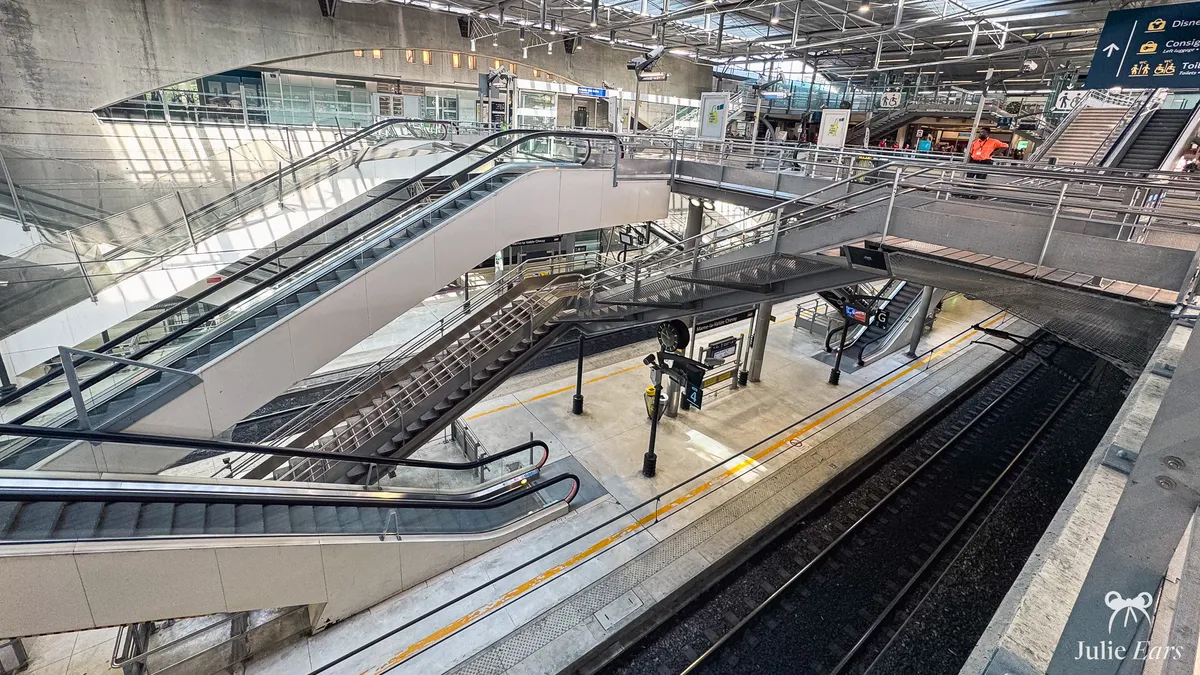
By RER from Paris
If you’re in Paris or stopping there along the way, the RER A commuter train is the most direct option: it runs from central Paris to the end of the line at Marne-la-Vallée/Chessy in 35 to 40 minutes, with no transfers. It’s also the easiest way to pair a day at the park with a day in the city. I go over the stops and tickets in my RER A guide.
By car: access and highways
Driving still makes sense, particularly for long trips, families, or anyone hauling a lot of bags. To reach Disneyland Paris, take the A4 highway to exit 14 (Parcs Disney), and signs will guide you in as you approach. What I like about it: the huge parking lot, with over 11,000 spaces, sits right by the entrance and is simple to pull into, so arrival is a breeze.
Budget for tolls along your route and for parking (it isn’t free). A Crit’Air sticker is only required when your route crosses Paris, since the park lies outside the low-emission zone. My parking guide has everything on parking, and my dedicated article explains the Crit’Air rules.
By plane: from the airports
If you’re coming from far away or from abroad, you’ll land at one of Paris’s two airports: Charles de Gaulle (also called Roissy) or Orly. From there, you have several ways to reach the park: the Magical Shuttle (paid, from €24, serving the Disney hotels), the RER, a direct TGV from Roissy, or a taxi or rideshare (the most comfortable but the priciest). I compare travel times and prices in my guide from Orly and Roissy airports and my Magical Shuttle guide.
By bus: the cheapest option
Long-distance bus companies (FlixBus and others) serve the area from many cities, often at very low fares. It’s a budget-friendly choice, but watch out: few routes go straight to the park. Most of the time, you’ll need to get to Paris or an airport first, then switch to the RER or a shuttle for the last few kilometers.
Shuttles once you’re there
After you arrive, a car usually isn’t necessary. Free shuttle buses run to most Disney hotels and plenty of partner hotels. You can walk to the parks from most of the Disney hotels. The exception is Davy Crockett Ranch, which sits farther away and has no shuttle, so driving is a must there (its guests park at the parks for free).
My hotel shuttle guide goes into all the details. In short: staying at a Disney hotel or at a partner hotel on a shuttle route means you can do without a car.
Based on your starting point
The best option really depends on where you’re starting from. Here are the general trends:
- From Paris: the RER A, direct and fast (35 to 40 minutes).
- From northern France (Lille, Calais, Amiens): direct TGV or OUIGO trains, or the A1 highway and then the A4.
- From eastern and southern France (Lyon, Marseille, Strasbourg): direct TGVs to Marne-la-Vallée/Chessy, often the fastest option.
- From western and southwestern France (Brittany, Normandy, Bordeaux): TGV, sometimes with a change in Paris, or the road.
- From Belgium: direct Eurostar to Marne-la-Vallée/Chessy.
- From Switzerland and Luxembourg: a train into Paris, a station change, and then the RER A out to the park, or simply drive if you live near the border.
Either way, weigh the train against the car based on how many of you are going: for a group, driving can be the better deal, while for one or two travelers, the train often comes out ahead.
How should you get there, depending on your travel style?
The right choice changes depending on who you’re traveling with:
- First visit: go by train for a hassle-free trip, since you won’t have to drive or find a parking space and you step off right by the park. My pointers are in the first-time visitor guide.
- Family with kids: no need for a car if you’re staying at a Disney hotel (free shuttles), and the train is easy with a stroller. See the family hub.
- With friends: in a group, carpooling or a long-distance bus can bring the cost down. Ideas in the friends group hub.
- Guests with disabilities or reduced mobility: the station, the RER, and the hotel shuttles are accessible, and everything is step-free between the station and the parks. It’s all in the accessibility hub.
Affiliate link · Disney’s official prices
Frequently asked questions
01 How do you get to Disneyland Paris?
There are four main ways in: the train (direct TGV, OUIGO, or Eurostar), the RER A all the way to its last stop, Marne-la-Vallée Chessy, the car via the A4 highway (exit 14, Parcs Disney), or a flight into one of the Paris airports (CDG or Orly) followed by a shuttle. I go through each one in my dedicated articles.
02 Which train station serves Disneyland Paris (TGV, RER, OUIGO, Eurostar)?
There’s only one: Marne-la-Vallée Chessy. TGV, OUIGO, and Eurostar trains all stop there, and it’s also the last stop on the RER A. Depending on your train, you can get there without changing from Paris, CDG airport, Lille, Lyon, Marseille, or Brussels (coming from London means one change, in Lille or Paris).
03 How far is the walk from the station to the parks?
It’s roughly a 5-minute walk. Step off the train, cross Disney Village, and you’re at the security check for the parks. You won’t need a shuttle.
04 Which shuttle can you take from CDG or Orly airport?
Several options: the Magical Shuttle bus (paid, serves the Disney hotels), the RER B then RER A with a change at Châtelet-Les Halles, or a direct TGV from CDG (the fastest). I go over prices and travel times in my dedicated article.
05 Are there shuttles between the Disney hotels and the parks?
Yes, free shuttles serve most of the official Disney hotels. Some hotels are also within walking distance (Disneyland Hotel, Hotel New York, Newport Bay Club, Sequoia Lodge). The Davy Crockett Ranch has no shuttle, so you really need a car there (its guests get free parking at the parks). You’ll find the schedule at the hotel front desk or in the Disneyland Paris app.
06 Is a car necessary to get to Disneyland Paris?
No. The park is very easy to reach: the RER A (Paris commuter train) stops at the entrance, trains run from the airports, and the Disney hotels offer free shuttles. A car is mostly useful for exploring the area or if you’re staying farther away.
07 Arriving by train: where do I drop my bags?
At Marne-la-Vallée/Chessy station, automatic lockers let you drop off your suitcases before heading into the parks. If you’re staying at a Disney hotel, its luggage storage is free, even before check-in. It’s all explained in luggage storage.


